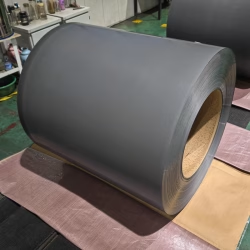

Carbon steel plate is one of the world’s most widely used engineering materials, supporting applications ranging from commercial buildings and bridges to pressure vessels, offshore structures, mining equipment, heavy machinery, and industrial infrastructure. This comprehensive guide explains how carbon steel plates are manufactured, classified, selected, inspected, fabricated, and supplied for international engineering projects.
What Is Carbon Steel Plate?
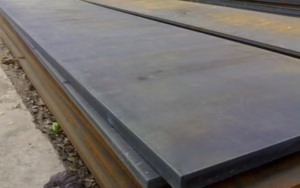
Carbon steel plate is a flat-rolled steel product manufactured primarily from iron and carbon with carefully controlled amounts of manganese, silicon, phosphorus, sulfur, and other alloying elements. It is widely used in structural engineering, pressure vessels, bridges, machinery, shipbuilding, mining, and heavy industrial applications because it provides an excellent balance of strength, weldability, machinability, availability, and cost-effectiveness.
Depending on the application, carbon steel plates may be supplied in various grades, thicknesses, delivery conditions, and international standards such as ASTM, EN, GB, JIS, AS/NZS, and CSA. Selecting the correct material requires consideration of mechanical properties, service environment, fabrication methods, inspection requirements, and project specifications rather than price alone.
What Is Carbon Steel Plate?
Carbon steel plate is a hot-rolled flat steel product designed for structural and engineering applications that require high strength, reliable weldability, and economical manufacturing. Unlike stainless steel, carbon steel does not contain sufficient chromium to provide inherent corrosion resistance. Instead, it achieves excellent structural performance through optimized chemical composition, controlled rolling, and, where required, heat treatment.
The versatility of carbon steel plate makes it suitable for a broad range of industries, including commercial construction, transportation infrastructure, pressure equipment, energy production, heavy manufacturing, marine engineering, and mining operations. Modern steel mills manufacture plates in numerous widths, lengths, thicknesses, and strength levels to satisfy international engineering standards and customer specifications.
Key Characteristics
- Excellent strength-to-cost ratio
- Outstanding weldability for most structural grades
- Good machinability and formability
- Available in a wide range of dimensions
- Manufactured according to internationally recognized standards
- Suitable for numerous fabrication processes
| Property | Description |
|---|---|
| Primary Material | Iron with controlled carbon and alloying elements |
| Manufacturing Method | Hot rolling followed by optional heat treatment |
| Typical Thickness | 3 mm to over 300 mm depending on mill capability |
| Common Standards | ASTM, EN, GB, JIS, AS/NZS, CSA |
| Main Advantages | Strength, weldability, availability and competitive cost |
| Typical Industries | Construction, energy, mining, manufacturing, marine and infrastructure |
Advantages of Carbon Steel Plate
Carbon steel plate continues to dominate structural engineering because it offers one of the best combinations of mechanical performance, manufacturing efficiency, and economic value. Rather than maximizing a single property, it delivers balanced performance across multiple engineering requirements, making it suitable for thousands of industrial applications.
For most structural projects, selecting the appropriate carbon steel grade provides a more practical and cost-effective solution than specifying stainless steel or high-alloy materials with unnecessary performance characteristics.
| Advantage | Engineering Benefit |
|---|---|
| High Strength | Supports demanding structural applications with reliable mechanical performance. |
| Excellent Weldability | Compatible with common welding processes used worldwide. |
| Good Machinability | Suitable for cutting, drilling, milling, forming and machining. |
| Global Availability | Produced by steel mills across all major industrial regions. |
| Wide Grade Selection | Available for structural, pressure vessel, wear-resistant and offshore applications. |
| Competitive Cost | Provides excellent lifecycle value for engineering projects. |
| Established Standards | Supported by internationally recognized specifications and design codes. |
Successful material selection is not about choosing the strongest steel—it is about choosing the most appropriate steel for the project’s design requirements, fabrication methods, operating environment, and expected service life.
Types of Carbon Steel Plate
Carbon steel plates are manufactured in several categories, each developed for specific engineering applications. Understanding these categories simplifies material selection and helps prevent specification errors during procurement.
| Category | Representative Grades | Primary Applications |
|---|---|---|
| General Structural Steel | ASTM A36, Q235B, S235JR, SS400 | Buildings, warehouses, fabrication and general construction |
| High-Strength Structural Steel | ASTM A572 Grade 50, Q355B, S355JR | Bridges, industrial buildings and heavy structures |
| Pressure Vessel Steel | ASTM A516 Grade 70, Q345R, P355GH | Boilers, pressure vessels and storage tanks |
| Shipbuilding Steel | AH36, DH36, EH36 | Ship hulls and offshore structures |
| Wear-Resistant Steel | AR400, AR500, NM400, NM500 | Mining equipment and abrasion-intensive applications |
| HSLA Steel | A572 Series, S355 Series, Q355 Series | Projects requiring higher strength with reduced structural weight |
“`
International Standards for Carbon Steel Plate
Carbon steel plates are manufactured according to nationally and internationally recognized standards that define chemical composition, mechanical properties, dimensional tolerances, testing methods, and delivery requirements. Selecting the correct standard is essential for ensuring regulatory compliance, engineering compatibility, and project acceptance.
Although many grades from different countries exhibit similar performance, they are not automatically interchangeable. Each standard establishes its own technical requirements, certification procedures, and inspection criteria. Any substitution should therefore be reviewed and approved by the project’s design engineer or responsible authority.
| Standard | Region | Typical Grades | Primary Applications |
|---|---|---|---|
| ASTM | United States | A36, A572, A516, A514 | Construction, bridges, pressure vessels and heavy industry |
| EN 10025 | Europe | S235JR, S275JR, S355JR | Structural engineering and infrastructure |
| GB/T | China | Q235B, Q355B, Q345R | General construction and industrial fabrication |
| JIS | Japan | SS400, SM490A | Buildings, machinery and shipbuilding |
| AS/NZS 3678 | Australia & New Zealand | Grade 250, Grade 350 | Structural steel fabrication |
| CSA G40.21 | Canada | 260W, 350W | Commercial and infrastructure projects |
Important Note
Equivalent grades listed in different standards should be treated as engineering references rather than direct replacements. Differences in chemical composition, impact testing requirements, manufacturing practices, or certification may affect project compliance.
Carbon Steel Plate Grade Equivalents
International projects frequently involve multiple design standards and supply chains. Engineers therefore often compare equivalent grades from ASTM, EN, GB, and JIS standards during material selection. While many grades offer comparable strength levels, equivalency should always be verified against the applicable specification.
| ASTM | EN | GB | JIS | Typical Application |
|---|---|---|---|---|
| A36 | S235JR | Q235B | SS400 | General structural steel |
| A572 Grade 50 | S355JR | Q355B | SM490A | High-strength structural applications |
| A516 Grade 70 | P355GH | Q345R | SB450 | Pressure vessels and boilers |
| A514 | S690QL | Q690D | — | High-strength engineering structures |
Engineering Recommendation
Always compare the complete material specification—including yield strength, tensile strength, impact toughness, chemical composition, delivery condition, and inspection requirements—before approving an equivalent grade.
Chemical Composition of Carbon Steel Plate
The mechanical performance of carbon steel plate is fundamentally determined by its chemical composition. Carbon provides strength and hardness, while other alloying elements improve toughness, weldability, machinability, and overall manufacturing consistency.
Modern steelmaking controls these elements within narrow limits to produce consistent mechanical properties while satisfying the requirements of international material standards.
| Element | Primary Function |
|---|---|
| Carbon (C) | Increases strength and hardness but reduces weldability when excessive. |
| Manganese (Mn) | Improves strength, toughness and hot-working characteristics. |
| Silicon (Si) | Acts as a deoxidizer and increases strength. |
| Phosphorus (P) | Usually controlled at low levels to maintain toughness. |
| Sulfur (S) | Restricted to improve weldability and ductility. |
| Niobium (Nb) | Refines grain structure in HSLA steels. |
| Vanadium (V) | Improves yield strength through precipitation strengthening. |
| Titanium (Ti) | Enhances grain refinement and toughness. |
Why Carbon Content Matters
As carbon content increases, strength and hardness generally improve. However, higher carbon levels also reduce weldability, increase brittleness, and may require preheating or additional welding controls during fabrication.
Mechanical Properties of Carbon Steel Plate
Mechanical properties determine whether a steel plate can safely withstand the loads, temperatures, and service conditions encountered during operation. Engineers evaluate these properties during material selection to ensure compliance with applicable design codes.
| Property | Engineering Significance |
|---|---|
| Yield Strength | Stress at which permanent deformation begins. |
| Tensile Strength | Maximum stress before fracture. |
| Elongation | Indicates ductility and forming capability. |
| Charpy Impact Value | Measures toughness under dynamic loading. |
| Hardness | Represents resistance to indentation and wear. |
| Fatigue Resistance | Determines performance under cyclic loading. |
Design Consideration
Higher strength is not always the optimal choice. Material selection should balance strength, ductility, weldability, fatigue performance, manufacturability, and long-term durability according to the project’s engineering requirements.
Common Applications of Carbon Steel Plate
Because of its versatility, carbon steel plate is used across nearly every industrial sector. Different grades are selected according to structural loads, operating temperatures, abrasion levels, corrosion exposure, and fabrication requirements.
| Industry | Typical Components | Common Grades |
|---|---|---|
| Construction | Columns, beams, floor systems | A36, S355JR, Q355B |
| Bridge Engineering | Bridge girders and support members | A572 Grade 50, S355JR |
| Pressure Equipment | Pressure vessels, boilers, storage tanks | A516 Grade 70, Q345R |
| Mining | Buckets, liners, chutes | AR400, NM400, AR500 |
| Shipbuilding | Hull structures and decks | AH36, DH36, EH36 |
| Manufacturing | Machine bases, platforms and equipment frames | A36, SS400, Q235B |
| Energy | Power plants, wind towers and industrial facilities | A572 Grade 50, S355JR |
How to Select the Right Carbon Steel Plate
Selecting the appropriate carbon steel plate requires balancing structural performance, fabrication efficiency, inspection requirements, service conditions, and project cost. Rather than selecting the highest-strength material available, engineers evaluate the complete operating environment and applicable design standards before specifying a steel grade.
An effective material selection process minimizes technical risk, simplifies fabrication, and reduces the total cost of ownership throughout the structure’s service life.
| Selection Factor | Questions to Consider | Engineering Recommendation |
|---|---|---|
| Application | What is the component used for? | Select grades designed for the intended service. |
| Load Conditions | Static or dynamic loading? | Higher-strength steels may reduce structural weight. |
| Operating Temperature | Will the structure operate in low temperatures? | Specify impact-tested materials where required. |
| Corrosion Exposure | Indoor, outdoor, marine or chemical environment? | Apply suitable coatings or corrosion protection systems. |
| Fabrication | Will welding or forming be required? | Prioritize good weldability and ductility. |
| Inspection | Are UT or third-party inspections required? | Include inspection requirements in procurement documents. |
| Certification | Is EN 10204 Type 3.1 required? | Confirm documentation before production begins. |
Engineering Best Practice
Material selection should begin with the project specification—not the supplier’s inventory. Clearly defining performance requirements before requesting quotations improves pricing accuracy and reduces the risk of non-compliant deliveries.
How to Select the Appropriate Plate Thickness
Plate thickness directly influences structural capacity, fabrication methods, transportation costs, and welding procedures. Selecting a thicker plate does not automatically improve structural performance and may increase manufacturing complexity without providing measurable engineering benefits.
| Thickness | Typical Applications | Fabrication Notes |
|---|---|---|
| 3–10 mm | Light fabrication, brackets and machine covers | Excellent for laser cutting and forming |
| 10–25 mm | General structural fabrication | Most common commercial thickness range |
| 25–50 mm | Heavy structural members | Preheating may be required for welding |
| 50–100 mm | Pressure vessels and bridge components | Higher inspection requirements are common |
| Over 100 mm | Mining, offshore and heavy engineering | Special rolling capability and extended lead times may apply |
How Carbon Steel Plate Is Manufactured
Modern carbon steel plate production combines advanced steelmaking, precision rolling, and strict quality control to produce consistent mechanical properties and dimensional accuracy. While production routes differ between steel mills, the manufacturing sequence generally follows the same fundamental stages.
- Ironmaking using blast furnace or direct reduction processes.
- Primary steelmaking in a basic oxygen furnace (BOF) or electric arc furnace (EAF).
- Secondary refining to adjust chemical composition and remove impurities.
- Continuous casting to produce steel slabs.
- Reheating prior to rolling.
- Hot rolling to the required thickness.
- Controlled cooling or heat treatment.
- Inspection, testing and dimensional verification.
- Surface preparation, marking and export packaging.
| Production Stage | Main Objective |
|---|---|
| Steelmaking | Produce molten steel with controlled chemistry. |
| Secondary Refining | Improve cleanliness and alloy consistency. |
| Continuous Casting | Create sound steel slabs. |
| Hot Rolling | Achieve required dimensions and refine grain structure. |
| Heat Treatment | Optimize strength and toughness where specified. |
| Inspection | Verify compliance with standards and customer specifications. |
Delivery Conditions
Delivery condition refers to the metallurgical condition of a steel plate when supplied by the manufacturer. It significantly influences mechanical properties, residual stress, weldability, and structural performance.
| Condition | Description | Typical Applications |
|---|---|---|
| AR (As Rolled) | No additional heat treatment after rolling. | General structural fabrication. |
| N (Normalized) | Reheated and air cooled to refine grain structure. | Pressure vessels and structural applications. |
| NR (Normalized Rolled) | Controlled rolling to achieve normalizing effects. | Structural engineering. |
| TMCP | Thermo-mechanical controlled processing. | Offshore and HSLA applications. |
| QT (Quenched and Tempered) | Quenched then tempered for high strength. | Heavy machinery and wear-resistant applications. |
Procurement Reminder
Always specify both the material grade and the required delivery condition. Two plates with the same grade but different delivery conditions may exhibit significantly different mechanical properties.
Heat Treatment of Carbon Steel Plate
Heat treatment modifies the internal microstructure of steel to achieve specific combinations of strength, toughness, hardness, and ductility. Not every carbon steel plate requires heat treatment, but many pressure vessel, high-strength, and wear-resistant grades depend on carefully controlled thermal processing.
| Process | Main Purpose | Engineering Benefit |
|---|---|---|
| Normalizing | Refine grain structure. | Improves toughness and consistency. |
| Annealing | Reduce hardness. | Improves machinability and formability. |
| Quenching | Increase hardness. | Enhances wear resistance. |
| Tempering | Reduce brittleness after quenching. | Improves ductility and impact resistance. |
| Stress Relieving | Reduce residual stresses. | Improves dimensional stability after welding. |
Welding Carbon Steel Plate
One of the primary reasons carbon steel plate is widely used in structural engineering is its excellent weldability. Most low-carbon and low-alloy structural steels can be welded successfully using conventional welding processes when appropriate procedures, consumables, and heat input controls are applied.
However, weldability is influenced by several factors, including carbon content, carbon equivalent (CE), plate thickness, hydrogen control, and service conditions. Higher-strength steels generally require more stringent welding procedures than ordinary structural grades.
| Factor | Effect on Welding | Recommendation |
|---|---|---|
| Carbon Content | Higher carbon reduces weldability. | Select low-carbon grades where practical. |
| Carbon Equivalent (CE) | Higher CE increases cracking susceptibility. | Evaluate CE before developing welding procedures. |
| Plate Thickness | Thicker plates cool more rapidly and retain greater residual stress. | Consider preheating and controlled heat input. |
| Hydrogen Level | Hydrogen may contribute to delayed cracking. | Use low-hydrogen consumables and proper storage. |
| Ambient Temperature | Cold environments increase cracking risk. | Follow applicable preheat requirements. |
Common Welding Processes
| Process | Advantages | Typical Applications |
|---|---|---|
| SMAW (Shielded Metal Arc Welding) | Simple equipment and high versatility. | Field construction and repair work. |
| GMAW (MIG/MAG) | High productivity and good weld appearance. | General fabrication. |
| FCAW (Flux-Cored Arc Welding) | High deposition rate. | Heavy structural fabrication. |
| SAW (Submerged Arc Welding) | Excellent quality for long welds. | Pressure vessels, beams and heavy plate fabrication. |
| GTAW (TIG) | Superior precision and weld quality. | Root passes and critical components. |
Best Practice
For critical structures, prepare a qualified Welding Procedure Specification (WPS) supported by a Procedure Qualification Record (PQR). Appropriate welder qualification and inspection should be completed before production welding begins.
Machining and Fabrication
Carbon steel plate offers excellent fabrication characteristics and can be processed using a wide range of conventional manufacturing methods. The optimal process depends on material grade, plate thickness, dimensional accuracy, production volume, and project requirements.
| Process | Typical Use | Main Advantages |
|---|---|---|
| Laser Cutting | Thin to medium plate | Excellent dimensional accuracy and clean edges. |
| Plasma Cutting | Medium and thick plate | High productivity and economical operation. |
| Oxy-Fuel Cutting | Heavy plate | Suitable for very thick carbon steel. |
| CNC Drilling | Bolt holes and machining | Accurate hole positioning. |
| Bending | Formed structural components | Efficient production of complex shapes. |
| Plate Rolling | Cylinders and tanks | Produces curved sections with consistent geometry. |
| Milling | Precision machining | Improves dimensional accuracy and surface finish. |
Fabrication Consideration
Higher-strength steel grades generally require greater forming forces and larger minimum bending radii than conventional structural steels. Fabrication procedures should always follow the material manufacturer’s recommendations and applicable engineering standards.
Corrosion Protection for Carbon Steel Plate
Although carbon steel provides excellent mechanical performance, it requires appropriate corrosion protection when exposed to moisture, marine environments, industrial atmospheres, or chemical processes. Selecting an appropriate protection system extends service life, reduces maintenance costs, and improves long-term structural reliability.
| Protection Method | Main Benefit | Typical Applications |
|---|---|---|
| Shop Primer | Temporary protection during transportation and fabrication. | General structural steel. |
| Epoxy Coating | Excellent chemical and moisture resistance. | Industrial facilities and process plants. |
| Polyurethane Topcoat | UV resistance and decorative finish. | Outdoor structures. |
| Hot-Dip Galvanizing | Long-term corrosion protection. | Infrastructure and utility projects. |
| Weathering Steel | Forms a stable protective oxide layer. | Bridges and architectural structures. |
Selection Tip
Corrosion protection should be selected according to the expected service environment, inspection accessibility, maintenance strategy, and required design life rather than applying the same coating system to every project.
Inspection and Testing
Inspection verifies that carbon steel plates satisfy specified material standards, customer requirements, and project quality plans. Comprehensive inspection reduces procurement risk and ensures traceability throughout manufacturing, fabrication, and installation.
| Inspection Item | Purpose | Typical Standard |
|---|---|---|
| Chemical Analysis | Verify chemical composition. | ASTM / EN / GB specifications. |
| Tensile Test | Confirm mechanical strength. | ASTM A370 / ISO 6892. |
| Charpy Impact Test | Evaluate low-temperature toughness. | ISO 148 / ASTM A370. |
| Hardness Test | Verify hardness where applicable. | ASTM E10 / ISO 6506. |
| Ultrasonic Testing (UT) | Detect internal laminations. | ASTM A578 / EN 10160. |
| Dimensional Inspection | Verify thickness, width and flatness. | Applicable product standard. |
| Visual Inspection | Evaluate surface quality. | Manufacturer quality procedures. |
Common Non-Destructive Testing (NDT)
| Method | Detects | Typical Applications |
|---|---|---|
| UT | Internal discontinuities. | Pressure vessels and heavy structural steel. |
| MT | Surface and near-surface cracks. | Weld inspection. |
| PT | Open surface defects. | Machined components. |
| RT | Internal weld imperfections. | Critical welded assemblies. |
| PMI | Material grade verification. | Quality assurance and traceability. |
Material Certification and Documentation
Material certification provides documented evidence that the supplied carbon steel plate complies with the applicable material specification, inspection requirements, and contractual obligations. Complete documentation improves traceability, facilitates project acceptance, and supports long-term quality management throughout the service life of the structure.
International engineering projects commonly require inspection certificates, mechanical test reports, chemical analysis reports, and traceability records before materials can be released for fabrication or installation.
| Document | Purpose | Typical Requirement |
|---|---|---|
| Mill Test Certificate (MTC) | Confirms chemical composition and mechanical properties. | Required for most industrial projects. |
| EN 10204 Type 3.1 Certificate | Manufacturer-certified inspection document. | International engineering projects. |
| EN 10204 Type 3.2 Certificate | Validated by an independent inspection authority. | Critical pressure equipment and offshore projects. |
| Chemical Analysis Report | Verifies compliance with material chemistry. | Specified by customer or project standards. |
| Mechanical Test Report | Records tensile, yield, elongation and impact results. | Common for structural and pressure vessel steels. |
| NDT Report | Documents ultrasonic or other inspection results. | Required for critical applications. |
| Heat Number Traceability | Maintains identification from steelmaking to delivery. | Quality management and project traceability. |
Documentation Best Practice
Documentation requirements should be confirmed before production begins. Requesting additional certificates after manufacturing may require repeat inspections or may not be feasible if production records are no longer available.
Export Packaging and International Shipping
Proper packaging protects carbon steel plates against mechanical damage, corrosion, contamination, and handling risks during domestic transportation, ocean freight, warehousing, and final delivery. Export packaging should be selected according to transportation method, storage duration, destination climate, and customer requirements.
| Packaging Method | Purpose |
|---|---|
| Steel Strapping | Secure bundled plates during transportation. |
| Wooden Dunnage | Protect edges and facilitate forklift handling. |
| Moisture Barrier Film | Reduce condensation during ocean shipment. |
| Rust Preventive Oil | Provide temporary corrosion protection. |
| Protective Corner Guards | Reduce edge damage during loading and unloading. |
| Identification Marking | Maintain traceability throughout the supply chain. |
Pre-Shipment Checklist
- Confirm steel grade and applicable standard.
- Verify plate dimensions and quantity.
- Review heat number markings.
- Confirm inspection reports and certificates.
- Check surface condition before packing.
- Verify export packaging requirements.
- Prepare commercial and customs documentation.
- Confirm shipping marks and destination labels.
How to Choose a Reliable Carbon Steel Plate Supplier
Selecting a qualified supplier is as important as selecting the correct steel grade. Reliable suppliers consistently deliver compliant materials, complete documentation, dependable lead times, and technical support throughout procurement, fabrication, and installation.
Professional buyers evaluate suppliers using technical capability, quality systems, manufacturing capacity, inspection resources, and international supply experience instead of comparing quotations alone.
| Evaluation Area | Why It Matters |
|---|---|
| Manufacturing Capability | Confirms the ability to produce required grades, sizes and delivery conditions. |
| Quality Management | Demonstrates controlled production and inspection procedures. |
| Technical Support | Provides assistance with grade selection and specification review. |
| Inspection Capability | Supports mechanical testing, NDT and third-party inspections. |
| Traceability System | Maintains identification throughout manufacturing and delivery. |
| Export Experience | Improves logistics coordination and documentation accuracy. |
| Delivery Performance | Reduces project scheduling risks. |
| Customer References | Provides confidence through proven project experience. |
Procurement Advice
The lowest purchase price does not necessarily represent the lowest project cost. Delivery delays, rejected materials, incomplete documentation, and quality disputes often create significantly higher costs than the initial price difference.
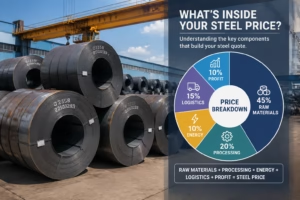
Factors That Influence Carbon Steel Plate Pricing
The cost of carbon steel plate depends on multiple technical and commercial factors. Understanding these variables enables buyers to compare quotations more accurately and optimize procurement strategies.
| Factor | Impact on Cost |
|---|---|
| Material Grade | Higher-strength and specialty grades generally command higher prices. |
| Plate Thickness | Very thick plates require greater rolling capacity and longer production times. |
| Dimensions | Non-standard sizes may increase manufacturing costs. |
| Heat Treatment | Additional processing increases production cost. |
| Inspection Requirements | NDT and third-party inspection add testing expenses. |
| Order Quantity | Larger orders generally improve manufacturing efficiency. |
| Lead Time | Expedited production may require premium pricing. |
| Export Packaging | Special packaging increases logistics costs. |
| Freight Charges | Transportation and shipping significantly affect total landed cost. |
Total Cost of Ownership
Rather than evaluating material price alone, experienced procurement teams assess the total cost of ownership (TCO). This includes fabrication efficiency, inspection requirements, transportation, maintenance, expected service life, and future replacement costs. A material with a higher purchase price may ultimately provide better economic value through improved durability and lower lifecycle expenses.
Engineering Case Studies
Industrial Warehouse Construction
A structural contractor selected ASTM A572 Grade 50 for the primary steel framework instead of a conventional structural grade. The higher yield strength allowed engineers to reduce member sizes while maintaining structural integrity, lowering overall steel consumption and simplifying transportation.
Pressure Vessel Manufacturing
A pressure equipment manufacturer specified ASTM A516 Grade 70 supplied in the normalized condition with EN 10204 Type 3.1 certification. Mechanical testing, ultrasonic inspection, and complete traceability ensured compliance with project specifications and accelerated client acceptance.
Mining Equipment Upgrade
A mining operation replaced conventional structural steel liners with abrasion-resistant plate for high-wear components. Although the initial material cost increased, longer service intervals and reduced maintenance significantly lowered overall operating costs.
Carbon Steel Plate Procurement Checklist
A well-prepared procurement specification helps ensure that the supplied material fully complies with engineering requirements while minimizing manufacturing delays, quality disputes, and unnecessary project costs. Before issuing a purchase order, review each of the following items carefully.
- ☐ Confirm the applicable material standard (ASTM, EN, GB, JIS, AS/NZS, or CSA).
- ☐ Specify the required steel grade.
- ☐ Confirm plate thickness, width, and length.
- ☐ Define acceptable dimensional tolerances.
- ☐ Specify the required delivery condition.
- ☐ Confirm mechanical property requirements.
- ☐ Determine whether impact testing is required.
- ☐ Specify ultrasonic testing requirements if applicable.
- ☐ Confirm surface condition and coating requirements.
- ☐ Request EN 10204 certification where required.
- ☐ Verify heat number traceability requirements.
- ☐ Confirm export packaging specifications.
- ☐ Review shipping terms and Incoterms.
- ☐ Confirm destination country documentation requirements.
- ☐ Establish inspection and acceptance procedures before production.
Procurement Best Practice
Issuing a complete technical specification before requesting quotations allows suppliers to provide accurate pricing, minimizes engineering changes during production, and significantly reduces the risk of receiving non-compliant material.
Frequently Asked Questions
What is carbon steel plate used for?
Carbon steel plate is widely used in structural engineering, commercial buildings, bridges, pressure vessels, storage tanks, heavy machinery, mining equipment, shipbuilding, energy facilities, transportation infrastructure, and industrial manufacturing because it offers an excellent balance of strength, weldability, and cost.
What is the difference between carbon steel plate and stainless steel?
Carbon steel provides excellent structural performance at a lower cost, while stainless steel offers superior corrosion resistance because of its chromium content. The most appropriate material depends on service environment, maintenance expectations, and project budget.
Which carbon steel grade is the most commonly used?
ASTM A36 is one of the world’s most commonly specified structural steel grades due to its excellent weldability, wide availability, and economical cost. Higher-strength applications frequently use ASTM A572 Grade 50 or equivalent materials.
Can ASTM A36 replace Q235B?
Although ASTM A36 and Q235B have comparable applications, they belong to different national standards and are not automatically interchangeable. Any substitution should be verified by comparing the complete material specification and approved by the project engineer.
Does thicker steel always provide higher strength?
No. Plate thickness increases load-carrying capacity, but material strength is primarily determined by the steel grade, manufacturing process, and delivery condition.
Can carbon steel plate be galvanized?
Yes. Hot-dip galvanizing is one of the most common methods for improving corrosion resistance in outdoor structural applications.
What is TMCP?
Thermo-Mechanical Controlled Processing (TMCP) is an advanced manufacturing process that combines controlled rolling and accelerated cooling to achieve high strength and excellent toughness without excessive alloying.
Is ultrasonic testing mandatory?
Ultrasonic testing is not required for every project. However, it is commonly specified for pressure vessels, bridges, offshore structures, and other critical applications where internal defects must be detected before fabrication.
What is EN 10204 Type 3.1 certification?
EN 10204 Type 3.1 is an internationally recognized inspection certificate issued by the manufacturer confirming that the supplied material complies with the applicable specification based on inspection and testing performed during production.
What affects the price of carbon steel plate?
Pricing depends on the steel grade, dimensions, plate thickness, manufacturing process, inspection requirements, heat treatment, order quantity, packaging, freight costs, and current raw material market conditions.
How should carbon steel plate be stored?
Steel plates should be stored on raised supports in a dry environment with adequate drainage. Proper identification, traceability, and protection against moisture help prevent corrosion and simplify inventory management.
What documents are normally supplied with carbon steel plate?
Typical documentation includes the Mill Test Certificate (MTC), EN 10204 inspection certificate (when specified), mechanical test reports, chemical analysis, inspection reports, packing list, commercial invoice, and traceability records.
Engineering Glossary
| Term | Definition |
|---|---|
| Yield Strength | The stress at which permanent deformation begins. |
| Tensile Strength | The maximum stress a material can withstand before fracture. |
| Elongation | A measure of ductility expressed as percentage extension. |
| Charpy Impact Test | A standardized test used to evaluate impact toughness. |
| Carbon Equivalent (CE) | An index used to estimate weldability. |
| TMCP | Thermo-Mechanical Controlled Processing. |
| UT | Ultrasonic Testing. |
| MT | Magnetic Particle Testing. |
| PT | Liquid Penetrant Testing. |
| PMI | Positive Material Identification. |
| MTC | Mill Test Certificate. |
| WPS | Welding Procedure Specification. |
| PQR | Procedure Qualification Record. |
| HAZ | Heat Affected Zone adjacent to a weld. |
| Traceability | The ability to identify material throughout manufacturing, inspection, and delivery. |
Conclusion
Carbon steel plate remains one of the most versatile and economical engineering materials available for structural, industrial, and manufacturing applications. Its combination of strength, weldability, machinability, broad availability, and compliance with international standards makes it the preferred material for countless projects around the world.
Successful material selection depends on understanding more than the steel grade alone. Engineers and procurement professionals should evaluate design requirements, operating conditions, fabrication methods, inspection requirements, certification, corrosion protection, and lifecycle cost before selecting a material. A systematic approach reduces technical risk, improves project efficiency, and delivers better long-term value.
Need Help Selecting the Right Carbon Steel Plate?
Whether you are sourcing structural steel plates for commercial construction, pressure vessel plates for industrial equipment, or high-strength materials for demanding engineering applications, selecting the right material is essential to project success.
Our technical team can assist with material selection, international grade comparison, engineering documentation, inspection requirements, export packaging, and worldwide logistics. We work closely with contractors, fabricators, EPC companies, distributors, and equipment manufacturers to deliver reliable steel plate solutions that meet international quality standards.
Technical Support Services
- Material Grade Selection
- International Grade Equivalency
- Engineering Documentation
- Mill Test Certificates (MTC)
- EN 10204 Type 3.1 Certification
- Third-Party Inspection Coordination
- Custom Cutting and Processing
- Global Export and Logistics Support
Contact our engineering team to discuss your project requirements and receive a customized carbon steel plate recommendation tailored to your technical and commercial needs.