
Introduction
As global shipbuilding capabilities continue to evolve, the industry is undergoing a significant transformation from quantity-focused production to quality-driven manufacturing. This shift is marked by the growing capacity to construct high-value vessels such as large container ships, liquefied gas carriers, and advanced drilling ships. With increasing vessel tonnage and more diverse ship types, the demand for shipbuilding steel plates with enhanced strength, superior toughness, and improved corrosion resistance has become the primary development direction for steel manufacturers worldwide.
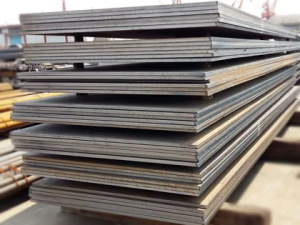
Dimensional Standards According to GB/T 5312-2009
Size Specifications
The GB/T 5312-2009 standard for “Carbon and Carbon-Manganese Steel Seamless Steel Tubes and Pipes for Ship” establishes comprehensive dimensional requirements for shipbuilding steel plates:
Standard Dimension Ranges:
-
Thickness: 6 mm to 650 mm
-
Width: 900 mm to 4,800 mm
-
Length: 3,000 mm to 27,000 mm
Weight Standards
-
Unit Area Weight: 7.85 kg/m² to 160 kg/m²
-
Note: Specific weight regulations may vary based on material composition and manufacturing processes
Permissible Dimensional Tolerances
Thickness Deviation:
-
Range: ±0.3 mm to ±3.0 mm
-
Variation depends on specific thickness and steel grade
Width Deviation:
-
Range: ±10 mm to ±50 mm
-
Determined by width specification and material grade
Length Deviation:
-
Range: ±100 mm to ±500 mm
-
Adjusted according to length requirements and steel classification
Enhanced Specifications Under GB/T 709-2019
Updated Dimension Standards
As referenced in GB/T 5312-2009, shipbuilding steel plates must also comply with GB/T 709-2019, which provides more refined dimensional specifications:
Refined Size Ranges:
-
Thickness: 1.5 mm to 60 mm
-
Width: 750 mm to 1,800 mm
-
Length: Custom lengths as per contractual negotiation
Weight Specifications
-
Steel plate weight is typically expressed in metric tons
-
Final weight calculation depends on specific dimensions and thickness
Precision Tolerance Requirements
Thickness Deviation Examples:
-
For plates 1.5 mm to 3.0 mm thick: ±0.10 mm
-
Tolerance varies progressively with increasing thickness
Width Deviation Standards:
-
For widths 750 mm to 1,800 mm: ±5 mm
-
Adjustments made for different width categories
Industry Application Correlations
Vessel Type and Plate Thickness Relationships
-
Standard Bulk Carriers: Typically utilize plates ranging from 6 mm to 25 mm
-
Large Container Ships: Require plates from 15 mm to 40 mm for hull integrity
-
Liquefied Gas Carriers: Employ specialized plates from 20 mm to 50 mm with enhanced low-temperature properties
-
Drilling Ships and Offshore Platforms: Utilize heavy plates from 30 mm to 650 mm for critical structural components
Advanced Manufacturing Considerations
The evolution toward high-value vessel construction demands increasingly precise dimensional control:
-
Laser Cutting Compatibility: Tighter tolerances for automated fabrication
-
Welding Efficiency: Consistent dimensions for high-speed assembly processes
-
Weight Optimization: Precise thickness control for vessel performance and fuel efficiency
Quality Assurance and Compliance
Dimensional Verification Processes
-
Laser Measurement Systems: For precise thickness verification
-
Automated Width Scanning: Ensuring consistent dimensional accuracy
-
Length Calibration: Advanced measuring techniques for long plates
Certification Requirements
-
Mill test certificates confirming compliance with dimensional standards
-
Third-party inspection reports for critical applications
-
Classification society approval for marine applications
Future Trends in Shipbuilding Steel Plate Sizes
Emerging Industry Requirements
-
Thinner High-Strength Plates: For weight reduction without compromising structural integrity
-
Wider Plate Formats: Reducing welding requirements and improving construction efficiency
-
Custom Length Solutions: Tailored to specific vessel design requirements
-
Enhanced Tolerances: Supporting automated shipbuilding technologies
Conclusion
The dimensional specifications for shipbuilding steel plates, as defined by GB/T 5312-2009 and GB/T 709-2019, provide a comprehensive framework supporting the shipbuilding industry’s evolution toward more sophisticated and higher-value vessel construction. The precise control over thickness, width, and length dimensions, coupled with strict tolerance requirements, ensures that modern shipbuilding steel plates meet the exacting standards required for advanced marine applications. As the industry continues to prioritize strength, toughness, and corrosion resistance, these dimensional standards will remain fundamental to producing high-quality vessels capable of operating in increasingly demanding marine environments.