China’s steel market stands at a crossroads of complex dynamics, with the tug-of-war between high supply and weak demand quietly playing out.
September 2025 began without the expected “strong opening” for the steel market. Instead, dragged down by over 4% declines in coking coal and coke, the main rebar contract (January) once fell below the 3,100 yuan/ton mark, while the near-month contract (October 2510) hit 3,029 yuan/ton – a nearly two-month low.
This is an unusual “Golden September” – the steel market opened weak amid ongoing tests to supply-demand dynamics. By the end of August, Lange Steel’s national composite steel price stood at 3,593 yuan/ton, down 58 yuan/ton from the previous month.
01 Market Status: Weak Supply and Demand, Inventories Keep Rising
The fundamental landscape facing the steel market in September is one of weakness in both supply and demand. Wang Jianhua, chief steel analyst at Shanghai Steel Union, pointed out that this fundamental pressure is continuing to build phase by phase, creating downward pressure on steel prices.
Inventory data shows that in August, social and mill inventories of the five major steel varieties increased by a combined 1.16 million tons, with social inventories rising by 1.04 million tons while mill inventories increased by only 120,000 tons.
From a product perspective, rebar social and mill inventories increased by 770,000 tons, making it the “star performer” in inventory buildup. This inventory structure change creates bearish pressure: circulation channel pricing is significantly more sensitive to social inventories than to mill inventories.
02 Demand Side: Construction Sector Weakness Remains Major Drag
The demand side shows a notable divergence: “manufacturing stable, construction weak.” The weakness in construction materials demand resulting from the ongoing property market bottoming remains the main drag.
In July, China’s commercial housing sales area decreased by 8.4% year-on-year, with the monthly decline widening compared to June. New construction starts in July also saw an expanded decline, falling 15.21% year-on-year monthly, with the decline rate widening by 5.73 percentage points from June.
The construction business activity index fell 1.5 percentage points to 49.1%, while the new orders index dropped significantly to 40.6%, reflecting weak demand for construction steel. Infrastructure investment growth also showed a moderating trend, with cumulative infrastructure investment completion up 7.29% year-on-year from January to July, but falling 1.93% year-on-year in July alone.
Manufacturing demand remains relatively stable. September will see seasonal recovery in domestic auto production and sales; home appliance production enters peak season, with plate demand expected to rebound sequentially; engineering machinery, machine tools and other production are marginally recovering with improving orders.
03 Supply Side: Mill Production Enthusiasm Remains High
Despite weak demand, steel supply shows no significant reduction. In August, weekly production of the five major varieties actually increased by 170,000 tons, reaching a monthly high of 8.85 million tons at the end of August.
As of August 25, daily molten iron output at 247 sample steel mills was 2.4075 million tons, little changed from the end of July. This level of molten iron production remains at a relatively high level of 2.4 million tons per day, providing strong demand support for raw materials.
In early September, Tangshan implemented phased production restrictions. As of September 1, all 23 sample steel enterprises with 89 blast furnaces had conducted shutdowns and maintenance according to plan, with 16 additional blast furnaces undergoing maintenance.
04 Cost Analysis: Raw Material Price Support Weakens
The cost side, once an important support factor for steel prices, is now showing signs of loosening. In August, coke prices experienced three rounds of increases.
By the end of August, the price of secondary metallurgical coke in the Tangshan area was 1,430 yuan/ton, up 150 yuan/ton from the end of July. However, some steel mills have announced reductions in coke procurement prices effective September 4, with dry-quenched coke falling 55 yuan/ton and wet-quenched coke dropping 50 yuan/ton.
In the iron ore sector, average prices moved higher in August. The average price of Australian 61.5% powder ore at Rizhao Port was 773 yuan/ton, up 19 yuan/ton from the previous month. However, with iron ore supply recovery relatively certain, price重心 may still move downward.
Driven by rising average raw material prices, monthly average cost levels increased significantly. The Lange pig iron cost index calculated using raw materials purchased in August was 103.4, up 6.4% from the previous month.
05 Industry Dynamics: Major Steelmakers Maintain Stable Pricing Policy
Facing market fluctuations, major steel enterprises have maintained pricing policy stability. On September 1, Shagang Group issued its early September ex-factory prices, keeping rebar, wire rod, and coil prices unchanged at 3,550 yuan/ton for rebar and 3,710 yuan/ton for coil.
On the same day, Zhongtian Steel also announced early September prices, keeping rebar, wire rod, and coil prices unchanged. East China rebar was priced at 3,400 yuan/ton, with wire rod and coil at 3,600 yuan/ton.
This indicates that despite short-term market fluctuations, major steel mills maintain relatively stable expectations for the medium-term market. The stability of mill pricing policies helps stabilize market sentiment to some extent.
06 Future Outlook: September Steel Prices May Fall First Then Rise
Synthesizing various viewpoints, there are some differences in the outlook for the September steel market, but most institutions believe it may show a pattern of falling first then rising.
Liu Huifeng, chief black metals researcher at Donghai Futures, believes that the month-on-month improvement in steel market demand in September is relatively certain, but considering current fundamentals, “demand will most likely fall short of expectations.”
New Lake black materials analysis points out that the quality of finished materials demand in September will determine the future price direction of finished materials. Looking at September demand expectations, finished materials demand is unlikely to show optimistic performance, and finished materials prices are expected to still face significant pressure.
Lange Steel Network predicts that China’s domestic steel market in September 2025 may show range-bound fluctuations, with the average price showing slight changes compared to the previous month.
07 Investment and Procurement Recommendations
For different market participants, we offer the following recommendations:
For steel mills: Loss-making mills should actively practice self-discipline in production control, saving production indicators for value creation.
For traders: Should appropriately prevent and control risks, operate cautiously, and consider whether to layout long positions in the futures market when prices are low. Should still prepare inventory for the September peak season.
For end users: Recommend purchasing when prices are low and rationally managing inventory using different markets.
At Zhongtang Metal (https://zhongtangmetal.com/), we are committed to providing comprehensive steel solutions for our clients. With warehouses and processing centers in multiple regions across China, we can respond promptly to customer needs and provide quality services.
With the Federal Reserve’s interest rate meeting scheduled for September 16-17, the market generally expects the Fed to cut rates by 25 basis points, which may help support a rebound in steel prices.
The market is also anticipating more domestic policy support. The China Index Academy expects September to usher in a密集 period of property policy introductions, with a new round of support policies expected under the “stop decline and stabilize” goal.
The quality of demand recovery during the traditional “Golden September and Silver October” peak season will become the key factor determining steel price trends in the second half of the year.
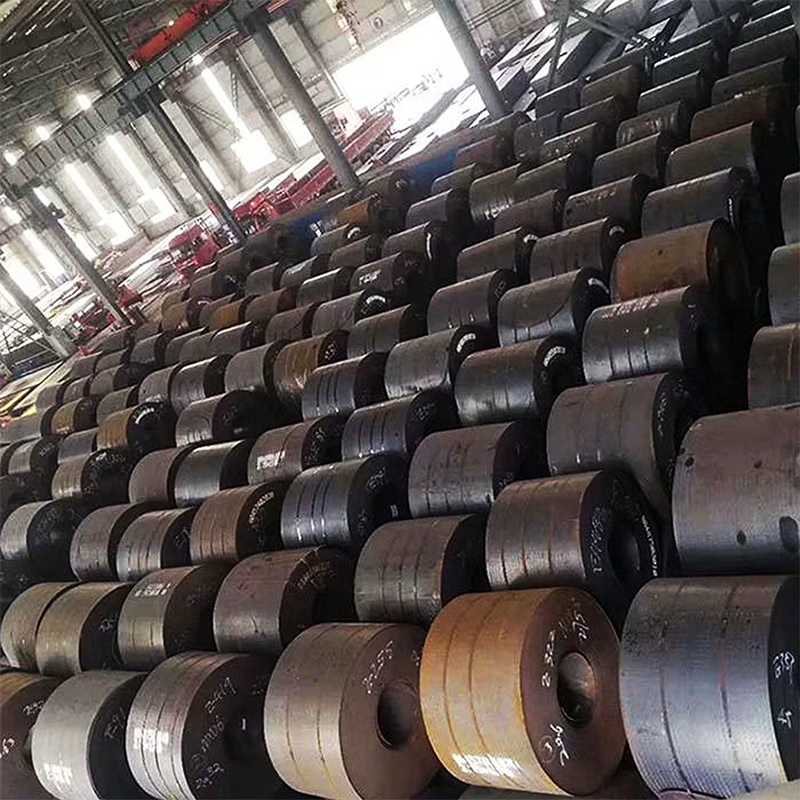
Image: Steel production in China continues at high levels despite market uncertainties. Source: China Iron and Steel Association
Key Data Points to Watch:
-
Weekly crude steel production data from CISA
-
Social inventory levels of five major steel products
-
Iron ore and coke price movements
-
Federal Reserve interest rate decision (Sept 16-17)
-
Chinese policy developments, especially regarding property market
Sources:
China Iron and Steel Association
Lange Steel Information Network
S&P Global Platts
World Steel Association
For the latest market updates and professional steel procurement solutions, visit Zhongtang Metal. Our team of experts provides timely market analysis and customized supply chain solutions for steel products across various industries.