
Introduction
Hot rolled steel coils represent one of the most fundamental and widely used steel products in modern industrial applications. Understanding their precise dimensional specifications is crucial for manufacturers, engineers, and procurement specialists across various sectors. This comprehensive guide provides detailed information about hot rolled steel coil sizes, their applications, and industry standards to help you make informed material selection decisions.
1. Understanding Hot Rolled Steel Coil Dimensions
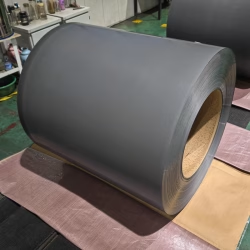
Unlike cylindrical products such as pipes or rods, hot rolled steel coils are characterized by their width and thickness rather than diameter. These flat steel products are wound into coils for efficient storage, transportation, and processing.
Key Dimensional Parameters:
-
Width: The horizontal measurement across the coil
-
Thickness: The vertical measurement through the steel material
-
Coil Weight: Total mass of the entire coil
-
Coil Diameter: The outer diameter of the wound coil (for handling purposes)
2. Standard Size Ranges
Width Specifications:
-
Minimum Width: 600mm
-
Maximum Width: 2,000mm
-
Common Intermediate Widths: 800mm, 1,000mm, 1,250mm, 1,500mm, 1,800mm
Thickness Specifications:
-
Thin Gauge Range: 1.2mm to 3.0mm
-
Medium Gauge Range: 3.0mm to 8.0mm
-
Heavy Gauge Range: 8.0mm to 25.0mm
3. Detailed Thickness Classification and Tolerances
| Thickness Category | Common Thickness (mm) | Allowable Deviation (±mm) | Minimum Thickness (mm) |
|---|---|---|---|
| Ultra Thin | 1.2 – 2.0 | 0.15 – 0.25 | 1.05 – 1.85 |
| Standard Thin | 2.0 – 3.0 | 0.25 – 0.35 | 1.85 – 2.75 |
| Light Gauge | 3.0 – 5.0 | 0.55 | 2.45 – 4.45 |
| Medium Gauge | 5.0 – 8.0 | 0.60 | 4.40 – 7.40 |
| Heavy Gauge | 8.0 – 15.0 | 0.65 | 7.35 – 14.35 |
| Extra Heavy | 15.0 – 25.0 | 0.75 | 14.25 – 24.25 |
4. Application-Based Size Selection
Automotive Industry Applications:
-
Recommended Sizes: 1.2mm – 3.0mm thickness, 800mm – 1,600mm width
-
Typical Uses: Body panels, structural reinforcements, chassis components
-
Key Considerations: Formability, surface quality, consistent gauge
Construction and Structural Applications:
-
Recommended Sizes: 3.0mm – 12.0mm thickness, 1,000mm – 2,000mm width
-
Typical Uses: Building frames, support structures, roofing, cladding
-
Key Considerations: Strength, weldability, corrosion resistance
Manufacturing and Industrial Applications:
-
Recommended Sizes: 6.0mm – 25.0mm thickness, 600mm – 1,800mm width
-
Typical Uses: Machinery components, equipment frames, storage tanks
-
Key Considerations: Durability, machinability, mechanical properties
Pipe and Tube Manufacturing:
-
Recommended Sizes: 2.0mm – 8.0mm thickness, 600mm – 1,500mm width
-
Typical Uses: Welded pipes, tubing, hollow sections
-
Key Considerations: Uniformity, edge condition, forming characteristics
5. Industry Standards and Quality Requirements
International Standard Compliance:
-
ASTM Standards: A1011, A569 for general requirements
-
JIS Standards: G3131, G3132 for specific applications
-
EN Standards: 10025, 10111 for European markets
-
GB Standards: 3274 for Chinese market requirements
Quality Assurance Parameters:
-
Dimensional accuracy and consistency
-
Surface quality and scale adherence
-
Mechanical properties verification
-
Coil integrity and winding quality
6. Processing Considerations
Handling and Storage:
-
Maximum coil weights based on thickness and width
-
Proper stacking procedures to prevent damage
-
Environmental protection requirements
-
Identification and tracking systems
Downstream Processing:
-
Slitting capabilities for width reduction
-
Leveling and cutting requirements
-
Surface treatment preparations
-
Forming and fabrication characteristics
7. Selection Guidelines
For High-Strength Applications:
-
Choose thicker gauges (8.0mm – 25.0mm)
-
Consider higher strength grades
-
Verify weldability requirements
For Forming and Stamping:
-
Select thinner gauges (1.2mm – 3.0mm)
-
Ensure consistent mechanical properties
-
Consider surface quality requirements
For Cost-Sensitive Projects:
-
Optimize width selection to minimize waste
-
Consider standard sizes for better availability
-
Evaluate total cost including processing
8. Technical Specifications Table
| Parameter | Specification Range | Industry Standards | Common Applications |
|---|---|---|---|
| Width | 600mm – 2,000mm | ASTM, JIS, EN, GB | All industrial sectors |
| Thickness | 1.2mm – 25.0mm | Various international standards | Automotive to heavy construction |
| Thin Gauge | 1.2mm – 3.0mm | ASTM A1011, JIS G3131 | Automotive panels, light fabrication |
| Medium Gauge | 3.0mm – 8.0mm | EN 10111, GB 3274 | General construction, manufacturing |
| Heavy Gauge | 8.0mm – 25.0mm | ASTM A569, JIS G3101 | Heavy equipment, structural applications |
9. Future Trends and Developments
Advanced Manufacturing:
-
Tighter tolerance capabilities
-
Improved surface quality
-
Enhanced mechanical properties
-
Custom size availability
Sustainability Initiatives:
-
Reduced environmental impact
-
Improved energy efficiency
-
Enhanced recyclability
-
Sustainable manufacturing practices
Conclusion
Understanding hot rolled steel coil sizes and specifications is essential for optimal material selection and efficient project execution. The comprehensive size range from 600mm to 2,000mm in width and 1.2mm to 25mm in thickness provides designers and engineers with versatile options for various applications.
By carefully considering the specific requirements of each project—including mechanical properties, fabrication needs, and cost considerations—professionals can select the most appropriate hot rolled steel coil sizes to ensure project success. The continued evolution of manufacturing technologies promises even more precise dimensional control and improved material properties in the future, further expanding the applications and benefits of hot rolled steel coils across all industrial sectors.