
Introduction
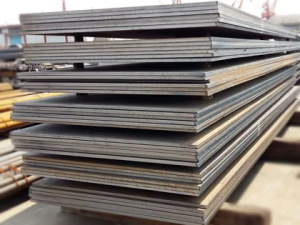
Low Alloy High Strength Steel Plates (HSLA) are engineered materials that provide superior mechanical properties while maintaining excellent fabrication characteristics. Understanding their dimensional specifications according to Chinese GB/T standards is crucial for engineers, designers, and procurement specialists in construction, manufacturing, and infrastructure development. This comprehensive guide details the size specifications and tolerances for HSLA plates under GB/T 1591-2018 and GB/T 3274-2017 standards.
GB/T 1591-2018 Dimensional Specifications
Size Range Overview:
-
Thickness: 3 mm to 150 mm
-
Width: 900 mm to 4,800 mm
-
Length: 3,000 mm to 25,000 mm
-
Weight Range: 1.5 tons to 25 tons per plate
Detailed Specifications:
| Parameter | Specification Range | Application Notes |
|---|---|---|
| Thickness | 3-150 mm | – Thin plates (3-20mm): Light structural components – Medium plates (20-50mm): Primary structural members – Thick plates (50-150mm): Heavy load-bearing applications |
| Width | 900-4,800 mm | – Standard widths: 1500, 1800, 2000, 2200 mm – Wide plates: 2500-4800 mm for large surface applications |
| Length | 3,000-25,000 mm | – Standard lengths: 6000, 8000, 10000, 12000 mm – Custom lengths available for specific project requirements |
GB/T 3274-2017 Dimensional Specifications
Size Range Overview:
-
Thickness: 6 mm to 200 mm
-
Width: 1,500 mm to 4,700 mm
-
Length: 3,000 mm to 27,000 mm
-
Weight Range: 1.5 tons to 20 tons per plate
Detailed Specifications:
| Parameter | Specification Range | Application Notes |
|---|---|---|
| Thickness | 6-200 mm | – Extended range for heavy industrial applications – Suitable for extreme load conditions |
| Width | 1,500-4,700 mm | – Optimized for modern construction requirements – Reduces welding requirements in large structures |
| Length | 3,000-27,000 mm | – Extra-long plates for continuous structural elements – Minimizes joints in large-scale projects |
Weight Calculation and Specifications
Standard Weight Ranges:
-
GB/T 1591-2018: 1.5 to 25 tons per plate
-
GB/T 3274-2017: 1.5 to 20 tons per plate
Weight Calculation Method:
Weight (kg) = Thickness (mm) × Width (mm) × Length (mm) × 0.00785
Practical Examples:
-
Plate: 20mm × 2000mm × 8000mm
-
Weight = 20 × 2000 × 8000 × 0.00785 = 2,512 kg
-
-
Plate: 50mm × 2500mm × 10000mm
-
Weight = 50 × 2500 × 10000 × 0.00785 = 9,812.5 kg
-
Allowable Dimensional Deviations
General Tolerance Principles:
-
Tolerances vary based on grade, thickness, and plate size
-
Stricter tolerances available for precision applications
-
Standard tolerances suitable for most structural applications
Dimensional Tolerances:
| Deviation Type | Typical Tolerance Range | Factors Affecting Tolerance |
|---|---|---|
| Thickness Deviation | ±0.1mm to ±2.0mm | – Plate thickness – Manufacturing process – Quality requirements |
| Width Deviation | +10mm to +30mm / -0mm | – Plate width – Cutting method – Edge condition requirements |
| Length Deviation | +20mm to +50mm / -0mm | – Plate length – Straightness requirements – End use application |
Shape Tolerances:
-
Straightness: Maximum deviation based on plate length
-
Flatness: Controlled within specified limits per meter
-
Edge Condition: Regular edges free from excessive imperfections
-
Surface Quality: Free from defects affecting structural integrity
Application-Based Size Selection
Construction and Building Applications:
-
Recommended Sizes:
-
Thickness: 6-40mm
-
Width: 1500-2500mm
-
Length: 6000-12000mm
-
-
Key Considerations:
-
Ease of handling and installation
-
Compatibility with standard structural elements
-
Optimal weight for lifting equipment
-
Bridge and Infrastructure Projects:
-
Recommended Sizes:
-
Thickness: 20-100mm
-
Width: 2000-4000mm
-
Length: 8000-20000mm
-
-
Key Considerations:
-
Long lengths to minimize field welding
-
Adequate thickness for load requirements
-
Width for efficient deck construction
-
Heavy Equipment and Machinery:
-
Recommended Sizes:
-
Thickness: 30-150mm
-
Width: 1800-3500mm
-
Length: 4000-15000mm
-
-
Key Considerations:
-
Thicker plates for wear resistance
-
Custom sizes for specific components
-
Weight optimization for mobile equipment
-
Quality Assurance and Inspection
Dimensional Verification:
-
Laser measurement systems for precise dimensioning
-
Ultrasonic thickness testing
-
Straightedge and gauge verification
-
Surface plate flatness checking
Certification Requirements:
-
Mill test certificates with actual dimensions
-
Third-party inspection reports
-
Compliance with project specifications
-
Traceability documentation
Inspection Protocols:
-
100% dimensional verification for critical applications
-
Statistical sampling for standard orders
-
Final inspection before shipment
-
Documentation of all measurements
Manufacturing and Fabrication Considerations
Cutting and Processing:
-
Plasma and laser cutting capabilities
-
Waterjet cutting for complex shapes
-
Oxy-fuel cutting for thicker plates
-
Machining allowances in tolerance calculations
Handling and Storage:
-
Special equipment for heavy plates
-
Proper stacking to prevent deformation
-
Environmental protection requirements
-
Identification and tracking systems
Transportation Planning:
-
Weight restrictions for road transport
-
Special permits for oversized plates
-
Loading and unloading equipment requirements
-
Route planning for large shipments
Industry Best Practices
Design Optimization:
-
Select standard sizes to minimize waste
-
Consider manufacturing capabilities during design
-
Account for tolerances in structural calculations
-
Optimize plate orientation for strength requirements
Procurement Strategies:
-
Clear specification of tolerance requirements
-
Verification of supplier capabilities
-
Consideration of both GB/T standards for comprehensive coverage
-
Early supplier involvement in project planning
Project Planning:
-
Lead time considerations for special sizes
-
Storage and handling requirements
-
Fabrication sequencing based on plate availability
-
Contingency planning for dimensional variations
Conclusion
The comprehensive size specifications provided by GB/T 1591-2018 and GB/T 3274-2017 standards ensure that Low Alloy High Strength Steel Plates meet the diverse requirements of modern construction and manufacturing industries. Understanding these dimensional parameters, along with their associated tolerances and weight considerations, enables optimal material selection and efficient project execution.
The wide range of available sizes, combined with precise tolerance controls, provides engineers and designers with the flexibility to create efficient, cost-effective structures while maintaining the highest standards of quality and safety. Proper implementation of these specifications contributes to successful project outcomes, reduced material waste, and enhanced structural performance across all applications.
As industry demands continue to evolve, these standards provide a solid foundation for material selection while allowing for the innovation and customization required by today’s complex engineering challenges.