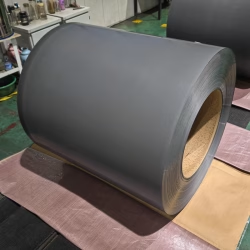
The steel industry is navigating a complex landscape of seasonal demand shifts, supply constraints, and macroeconomic influences. As we approach the traditional peak season, market participants are closely watching the delicate balance between cost support and demand recovery.
The global steel market is showing signs of cautious optimism as it transitions from the summer lull toward the anticipated “Golden September” peak season. With cost support remaining firm and demand expectations strengthening, prices are experiencing a stabilization phase after recent adjustments.
Current Market Dynamics
Price Performance and Trends
As of August 25, 2025, domestic steel prices in China have shown mixed performance across different product categories:
-
Rebar prices declined last week but stabilized with minor increases2
-
Hot rolled coil prices remained mostly steady1
-
Strip steel prices showed narrow fluctuations1
-
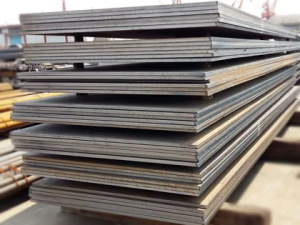
Plate prices held stable with individual adjustments1
The average price of Grade 3 seismic rebar across 31 major cities stood at ¥3,335/ton, down ¥7/ton from the previous trading session3. Shanghai’s rebar dollar price index closed at 453.3, declining 0.17%3.
Inventory and Supply Conditions
Steel inventories are showing signs of entering the final phase of the accumulation cycle:
-
Social inventory accumulation rate has slowed noticeably1
-
Overall inventory remains at relatively low levels4
-
Production levels continue at relatively high rates for the year1
The blast furnace operating rate and electric furnace operating rate indicate that steel mills continue to enhance production capacity1. However, some mills in Tangshan have reduced production due to profit and inventory pressures1.
Regional Market Analysis
Asian Market Focus
China, as the center of the global steel market, continues to influence global price trends:
-
Tangshan billet resources rose by ¥20/ton over the weekend to ¥3,040/ton3
-
Qian’an billet mainstream price is approximately ¥3,050/ton, up ¥30 from yesterday2
-
Iron ore inventories at 47 ports reached 14.4442 million tons, increasing by 626,300 tons2
The recent mine safety incidents in Fujian have prompted stricter safety inspections, potentially affecting supply chains2.
Raw Material Costs and Support
Key Input Price Trends
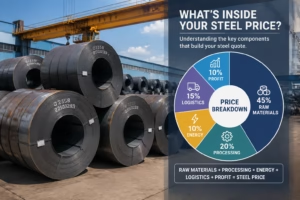
Raw material costs continue to provide strong support for steel prices:
| Raw Material | Price Trend | Key Influencing Factors |
|---|---|---|
| Iron Ore | High volatility | Port inventories increasing, demand resilience exists1 |
| Coking Coal | Steady with探涨 (probing increases) | Mine safety inspections, limited supply2 |
| Coke | Seventh price increase implemented | Eighth round of price increases initiated57 |
| Scrap Steel | Stable with individual adjustments | Tight resources, strong mill demand1 |
The comprehensive cost support for steel remains firm, particularly with coking coal prices showing strength due to supply constraints25.
Demand Outlook and Sectoral Analysis
Construction Sector
The construction materials market faces challenges:
-
Demand performance remains weak1
-
Downstream enterprises have insufficient operating rates1
-
Outdoor construction progress has slowed due to high temperatures and rainfall1
However, with improving fund availability for housing and infrastructure projects and the approaching peak season, market expectations for steel demand are strengthening1.
Manufacturing Sector
The manufacturing sector shows more resilience:
-
Automobile and home appliance steel demand continues to provide support2
-
Export orders continue to grow due to strong overseas industrial consumption4
-
The “replace old with new” policy for consumer goods continues to show effectiveness2
This manufacturing resilience has helped alleviate supply-demand contradictions4.
Macroeconomic Influences
Global Financial Environment
-
Federal Reserve Chair Powell turned more dovish, suggesting potential interest rate cuts2
-
Market expectations for a September rate cut have increased2
-
Potential transition to a global monetary easing cycle could benefit commodity markets2
Domestic Policy Support
-
New policy financial tools with ¥500 billion scale focused on emerging industries and infrastructure1
-
Local government bond issuance remained high near ¥900 billion in August2
-
“Replace old with new” policy continues to support auto and home appliance sales2
Corporate Performance and Strategy
Leading Steel Producers
China Baowu Steel Group has raised its September prices4:
-
Thick plate, hot rolled products, non-oriented silicon steel, and high aluminum zinc-aluminum magnesium plate increased by ¥200/ton
-
Pickled products, cold rolled products, hot galvanized plate, and electrogalvanized plate increased by ¥300/ton
This price adjustment reflects improving enterprise confidence and acceptable order pressure4.
Future Market Outlook
Short-term Projections (1-2 Weeks)
Market expectations suggest narrow adjustments in steel prices1:
-
Cost support remains relatively strong1
-
Seasonal demand improvement expected as weather conditions normalize1
-
Environmental protection controls in the Beijing-Tianjin-Hebei region may ease supply pressure1
Medium-term Considerations (Towards September)
The market is watching several key factors:
-
Implementation of blast furnace production restrictions in Hebei region2
-
Actual demand performance during the traditional peak season4
-
Export momentum sustainability given global trade patterns4
Strategic Recommendations for Market Participants
For Procurement Managers
-
Monitor raw material costs closely, especially coking coal and iron ore5
-
Consider gradual replenishment as demand season approaches4
-
Diversify supplier base to mitigate potential supply disruptions2
For Production Planners
-
Maintain flexible production schedules responsive to demand changes1
-
Focus on product mix optimization toward higher-margin products4
-
Monitor inventory levels carefully to balance working capital and service levels1
For Investors and Analysts
-
Track capacity utilization rates and inventory trends14
-
Monitor policy developments supporting infrastructure and manufacturing12
-
Watch global monetary policy changes affecting commodity markets2
Conclusion: Navigating the Transition Period
The steel market is in a transition phase from the seasonal slow period to the traditional peak season. While downside risks remain due to property sector weakness and weather-related demand suppression, upside potential exists from cost support, manufacturing resilience, and policy stimuli.
Market participants should maintain cautious optimism, closely monitoring raw material price movements, inventory changes, and the actual implementation of production restrictions. The balance between cost support and demand recovery will likely determine price trajectories in the coming weeks.
For more detailed market analysis and specialized steel products, visit Zhongtang Metal, your partner in navigating complex steel markets.
This report is based on market data available as of August 25, 2025. Market conditions may change rapidly, and readers should verify critical information before making business decisions.