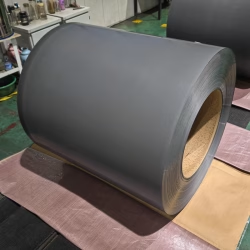
A Technical Guide to Surface Finish, Tolerances, Strength, and Application Selection
1. Quick Answer
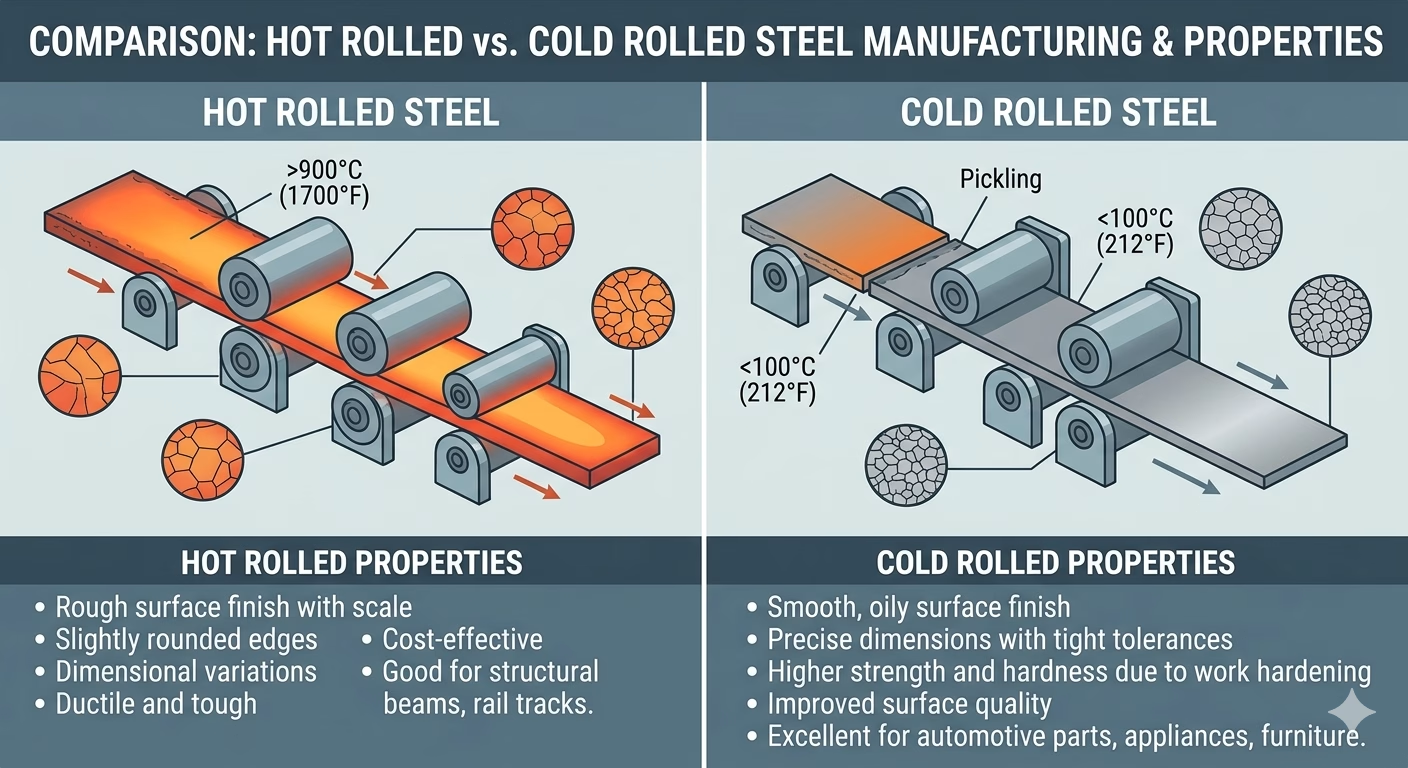
Cold rolled steel and hot rolled steel differ fundamentally in their processing: hot rolled steel is formed at high temperatures (above the steel’s recrystallization point, typically over 1,700°F / 930°C), while cold rolled steel undergoes additional processing at room temperature after hot rolling. This distinction creates significant differences: cold rolled steel offers smoother surface finish (Ra ≤ 0.8μm vs hot rolled’s mill scale surface), tighter dimensional tolerances (typically ±0.05mm vs ±0.1–0.2mm), and higher strength (20–30% higher yield strength due to strain hardening). Hot rolled steel is more economical and suitable for applications where surface finish and tight tolerances are not critical, such as structural beams, railroad tracks, and heavy equipment. Cold rolled steel is preferred for precision applications including automotive panels, appliances, furniture, and any component requiring exact dimensions and superior surface quality.
2. Key Takeaways
-
Cold rolled steel achieves tighter tolerances (typically ±0.05mm) because room-temperature rolling allows precise dimensional control, whereas hot rolling’s thermal expansion and contraction introduces greater variation.
-
Cold rolled steel exhibits 20–30% higher yield strength than hot rolled of the same grade due to strain hardening (work hardening) during the cold reduction process.
-
Surface finish differs dramatically—cold rolled steel has a smooth, often oily surface suitable for painting or plating without preparation, while hot rolled steel retains mill scale (oxide layer) that must be removed before finishing.
-
Hot rolled steel costs 15–25% less than cold rolled due to fewer processing steps, no cold reduction passes, and no annealing requirements for most applications.
-
Formability differs significantly—hot rolled steel is more ductile and suitable for severe forming, while cold rolled steel’s higher strength and lower ductility require consideration of bend radii.
-
Application selection depends primarily on tolerance and surface requirements—choose hot rolled when dimensions and surface finish are non-critical; choose cold rolled when precision, appearance, or consistent mechanical properties matter.
3. Terminology Snapshot
-
Hot Rolling — Forming steel at temperatures above recrystallization (typically 1,700–2,200°F / 930–1,200°C), allowing significant shape change with lower force.
-
Cold Rolling — Further processing hot-rolled steel at room temperature through reduction mills to achieve precise dimensions, improved surface, and enhanced mechanical properties.
-
Recrystallization Temperature — The temperature at which steel’s grain structure reforms (approximately 900–1,000°F / 480–540°C for most steels).
-
Strain Hardening (Work Hardening) — Increase in strength and decrease in ductility resulting from plastic deformation at room temperature.
-
Mill Scale — Iron oxide layer (Fe₂O₃, Fe₃O₄) formed on hot-rolled steel during high-temperature processing; rough, dark gray, and must be removed for painting.
-
Pickling — Acid bath process (typically hydrochloric or sulfuric) used to remove mill scale from hot-rolled steel.
-
Annealing — Heat treatment process that softens cold-rolled steel, relieves internal stresses, and restores ductility.
-
Skin Pass (Temper Rolling) — Light cold rolling (1–2% reduction) applied to improve surface finish and eliminate yield point elongation.
4. Understanding the User Problem
Engineers, fabricators, and procurement professionals searching for “cold rolled steel vs hot rolled steel” typically face one or more of the following challenges:
The Specification Problem: A drawing or specification calls for a steel product but doesn’t specify whether it should be hot or cold rolled. The buyer needs to understand the implications of each choice on performance, cost, and availability.
The Substitution Problem: A fabricator has hot rolled steel on hand but needs to produce a part specified for cold rolled. Can it be substituted? What are the risks? Conversely, can cold rolled replace hot rolled without excessive cost?
The Surface Finish Problem: A component requires painting or plating. The fabricator knows hot rolled steel has mill scale that interferes with coating adhesion. What’s the proper specification to ensure paintable surface?
The Tolerance Problem: A precision assembly requires consistent dimensions. Hot rolled tolerances are too loose for fit-up. The engineer needs to understand whether cold rolled can achieve required tolerances and at what cost.
The Strength Problem: A design requires specific mechanical properties. The engineer sees cold rolled has higher strength but isn’t sure if that comes from the process or from a different steel grade.
These questions all center on understanding the fundamental processing differences and how those differences translate to measurable performance attributes.
5. Manufacturing Process: From Hot to Cold
Hot Rolling Process
Hot rolling begins with steel that has been cast into slabs, blooms, or billets. The process follows these stages:
1. Reheating: Steel is heated to 1,700–2,200°F (930–1,200°C), well above its recrystallization temperature. At these temperatures, steel becomes highly plastic and can be deformed with significantly less force than at room temperature.
2. Roughing Rolling: The reheated steel passes through roughing stands that reduce thickness substantially. This stage breaks down the cast structure and begins shaping the material.
3. Finishing Rolling: The material passes through a series of finishing stands (typically 4–7 stands) that reduce thickness to final dimensions. Temperature control during this stage is critical for final properties.
4. Cooling: After the final stand, the steel is cooled—typically by water sprays or laminar cooling—to control final microstructure and mechanical properties.
5. Coiling: The finished strip is wound into coils weighing up to 30–40 metric tons.
Resulting Material Characteristics:
-
Surface: Covered with mill scale (iron oxide) from high-temperature exposure
-
Tolerance: Looser due to thermal expansion and contraction; typically ±0.1–0.2mm for light gauge
-
Mechanical Properties: Lower strength, higher ductility compared to cold rolled
-
Shape: Potential for residual stresses and slight warping
Cold Rolling Process
Cold rolling takes hot-rolled, pickled steel and processes it further at room temperature:
1. Pickling: Hot-rolled coils first pass through an acid bath (hydrochloric or sulfuric) to remove mill scale. This step is essential—mill scale is too hard and abrasive for cold rolling and would damage the rolls.
2. Cold Reduction: The pickled steel passes through rolling stands (typically 4–6 stands in tandem) at room temperature. Each stand reduces thickness by 10–30%, with total reduction typically 40–80%. This reduction creates strain hardening (work hardening), increasing strength by 20–30% while reducing ductility.
3. Annealing (Optional): For applications requiring maximum formability, the cold-rolled steel is annealed—heated to recrystallization temperature (1,200–1,400°F / 650–760°C) and slowly cooled. Annealing softens the steel, restores ductility, and relieves internal stresses.
4. Temper Rolling (Skin Pass): A light reduction (1–2%) applied to:
-
Improve surface finish
-
Eliminate yield point elongation (prevent stretcher strains during forming)
-
Achieve final dimensional tolerance
5. Finishing: Depending on application, steel may receive oiling, passivation, or other surface treatments.
Resulting Material Characteristics:
-
Surface: Smooth, often with residual rolling oil; ready for painting or plating
-
Tolerance: Tight; typically ±0.05mm or better
-
Mechanical Properties: Higher strength; consistent across coil
-
Shape: Excellent flatness; minimal residual stress
6. Key Differences Explained
6.1 Surface Finish
| Aspect | Hot Rolled | Cold Rolled |
|---|---|---|
| Surface Appearance | Dull gray with rough texture; mill scale present | Smooth, bright, often with residual oil |
| Surface Roughness (Ra) | 1.5–3.5μm typical | 0.5–1.5μm typical; can achieve <0.2μm on temper-passed material |
| Paint/Coating Preparation | Requires pickling or abrasive blasting to remove mill scale before painting | Can be painted directly after degreasing; ideal for powder coating |
| Cosmetic Applications | Not suitable for visible finished products | Preferred for exposed surfaces (automotive, appliances, furniture) |
Why the difference matters: Mill scale on hot rolled steel is an oxide layer that will flake off over time if painted directly, causing coating failure. Cold rolled’s clean surface eliminates this risk and provides superior base for decorative finishes.
For applications requiring paint or coating, see Galvanized Steel Coil for corrosion-resistant options.
6.2 Dimensional Tolerance
| Metric | Hot Rolled | Cold Rolled |
|---|---|---|
| Thickness Tolerance (0.3–1.0mm) | ±0.10–0.20mm | ±0.03–0.07mm |
| Thickness Tolerance (1.0–3.0mm) | ±0.15–0.30mm | ±0.05–0.10mm |
| Width Tolerance | ±3–6mm | ±1–2mm |
| Flatness | Moderate; may require leveling | Excellent; typically leveled in-line |
Why the difference matters: Cold rolling allows precise control of final dimensions because the process occurs at stable room temperature. Hot rolling’s high temperatures cause thermal expansion during rolling and contraction during cooling, creating greater variability.
Application impact: For automotive body panels, appliance housings, and precision assemblies, cold rolled tolerances are essential. For structural beams, railroad tracks, and heavy fabrication, hot rolled tolerances are adequate.
6.3 Mechanical Properties
For the same steel grade (e.g., 1008 carbon steel):
| Property | Hot Rolled | Cold Rolled (as-rolled) | Cold Rolled (annealed) |
|---|---|---|---|
| Yield Strength (MPa) | 210–280 | 350–550 | 210–280 |
| Tensile Strength (MPa) | 310–380 | 400–550 | 310–380 |
| Elongation (%) | 25–35 | 5–15 | 25–35 |
| Hardness (HRB) | 50–65 | 70–85 | 50–65 |
Why the difference matters: Cold rolling work-hardens steel, increasing strength but reducing ductility. This allows designers to achieve higher strength without changing steel chemistry—or to use lower-cost, lower-grade steel and achieve required properties through cold working.
Practical implication: Cold rolled steel can replace hot rolled in applications needing higher strength, but formability must be considered. Complex bends may require annealed cold rolled rather than as-rolled.
6.4 Cost Comparison
| Factor | Hot Rolled | Cold Rolled |
|---|---|---|
| Base Price Index | 1.0 (baseline) | 1.15–1.25 |
| Processing Steps | Fewer (reheat, roll, cool) | More (pickle, cold reduce, optionally anneal, temper) |
| Yield Loss | Lower | Higher (pickling loss, edge trim) |
| Energy Consumption | Higher per ton (reheating) | Higher per processing step but lower per ton for light gauges |
| Typical Applications Cost Impact | Structural: baseline | Precision: 15–25% premium |
Why the difference matters: Cold rolled steel’s additional processing steps—pickling, cold reduction, optional annealing, and temper rolling—add cost. However, for applications requiring tight tolerances or smooth surfaces, the premium is justified by reduced downstream processing (less machining, no surface preparation).
For cold rolled steel pricing and specifications, see Cold Rolled Steel Coil .
7. Comparison Table: Cold Rolled vs Hot Rolled Steel
| Feature / Metric | Cold Rolled Steel | Hot Rolled Steel | Best Use Case |
|---|---|---|---|
| Surface Finish | Smooth, bright, oiled; Ra ≤ 0.8μm | Rough, mill scale; Ra 1.5–3.5μm | Cold rolled for painted/appearance; hot rolled where surface doesn’t matter |
| Dimensional Tolerance | Tight; ±0.05mm typical | Loose; ±0.10–0.20mm typical | Cold rolled for precision assembly; hot rolled for structural where fit-up forgiving |
| Yield Strength* | 350–550 MPa (as-rolled) | 210–280 MPa | Cold rolled for higher strength without alloying |
| Ductility (Elongation) | 5–15% (as-rolled) | 25–35% | Hot rolled for severe forming; annealed cold rolled as alternative |
| Cost (per ton) | 15–25% premium | Baseline | Hot rolled for cost-sensitive non-critical applications |
| Thickness Range (Coil) | 0.12–3.0mm | 1.2–25mm+ | Cold rolled for thin gauges; hot rolled for thick sections |
| Formability | Moderate; requires bend radius consideration | Excellent; can be severely formed | Hot rolled for complex shapes; cold rolled for simpler bends |
| Paint/Coating Readiness | Ready after degreasing | Requires pickling or blasting | Cold rolled for painted products; hot rolled if pickling in-line |
| Residual Stress | Moderate (can be stress-relieved) | Moderate to high (from uneven cooling) | Both require stress relief for precision machining |
| Typical Applications | Automotive panels, appliances, furniture, precision tubing | Structural beams, railroad tracks, ship hulls, heavy equipment | Cold rolled for finished components; hot rolled for structural elements |
*For same steel chemistry; as-rolled condition
8. Strength and Formability Analysis
How Cold Rolling Increases Strength
Cold rolling’s strength increase comes from dislocation density. When steel is plastically deformed at room temperature, crystal lattice defects (dislocations) multiply and entangle, making further deformation more difficult—the material becomes stronger but less ductile.
Quantitative relationship:
For low-carbon steel, each 10% cold reduction typically increases yield strength by approximately 20–30 MPa, while elongation decreases by 2–4%.
Practical implications:
-
50% cold reduction (typical for light gauges): Yield strength may increase from 210 MPa to 350–400 MPa
-
80% cold reduction (very thin gauges): Yield strength may reach 500–550 MPa
When to Use Each Formability Characteristic
Choose Hot Rolled Steel When:
-
Complex bends with tight radii (R < 1.5× thickness)
-
Deep drawing operations
-
Severe forming where material must stretch significantly
-
Post-forming welding is required (lower carbon equivalent in as-rolled condition)
Choose Cold Rolled Steel When:
-
Moderate bends with adequate radii (R ≥ 1.5× thickness)
-
High strength required without heat treatment
-
Consistent mechanical properties across production run
-
Appearance after forming matters
If You Need Hot Rolled Formability with Cold Rolled Surface:
Specify annealed cold rolled steel—the annealing process recrystallizes the grain structure, restoring ductility while maintaining the smooth cold-rolled surface.
9. Applications by Process
Hot Rolled Steel Applications
| Industry | Applications | Why Hot Rolled |
|---|---|---|
| Construction | I-beams, H-beams, channels, angles, rail tracks | Large sections; strength adequate; surface finish not critical |
| Shipbuilding | Hull plates, structural members | Thick sections; weldable; cost-effective |
| Heavy Equipment | Excavator arms, bulldozer blades, crane booms | Impact resistance; heavy sections |
| Railroad | Rails, wheels, couplers | Wear resistance; large sections |
| Energy | Pipelines, wind tower sections | Weldable; thick sections available |
| Bridges | Structural members, decking | Structural capacity; corrosion allowance |
| Automotive | Frame rails, chassis components (certain applications) | Thicker sections where precision less critical |
Cold Rolled Steel Applications
| Industry | Applications | Why Cold Rolled |
|---|---|---|
| Automotive | Body panels, doors, hoods, fenders, roof panels | Smooth surface for paint; tight fit-up; consistent mechanical properties |
| Appliances | Refrigerator panels, washing machine drums, dishwasher tubs, microwave cabinets | Appearance; paintability; dimensional consistency |
| Furniture | Office desks, filing cabinets, shelving, chairs | Decorative finish; tight tolerances for assembly |
| HVAC | Ductwork, air handlers, furnace housings | Formability; consistent gauge for assembly |
| Construction | Metal studs, roof decking, wall panels, garage doors | Consistent gauge; paint-ready surface |
| Packaging | Steel drums, containers, strapping | Consistent strength; formability |
| Electronics | Computer cases, server racks, electrical enclosures | Precision fit; grounding properties; appearance |
For corrosion-resistant cold rolled products, see Galvanized Steel Coil for applications requiring both precision and protection.
10. When to Choose Each Process
Choose Hot Rolled Steel When:
Situation 1: Structural Applications Where Surface Finish Doesn’t Matter
-
Scenario: I-beams for building construction, railroad tracks, ship hull plates
-
Reason: These applications require strength and form but never require painting or cosmetic finish
-
Better Alternative: None—hot rolled is standard for structural sections
Situation 2: Thick Sections (>3.0mm)
-
Scenario: Heavy equipment fabrication, mining machinery, thick wall pipe
-
Reason: Cold rolling becomes impractical and cost-prohibitive for thick sections
-
Better Alternative: Hot rolled is the only economical choice for thick plates
Situation 3: Cost-Sensitive Non-Critical Applications
-
Scenario: Temporary structures, agricultural equipment where appearance irrelevant
-
Reason: Hot rolled’s 15–25% lower cost provides adequate performance
-
Better Alternative: Cold rolled only if tolerance or surface requirements justify premium
Situation 4: Severe Forming Operations
-
Scenario: Deep-drawn parts, complex geometries with tight radii
-
Reason: Hot rolled’s higher ductility (25–35% elongation) accommodates severe forming without cracking
-
Better Alternative: Annealed cold rolled can substitute but adds cost
Choose Cold Rolled Steel When:
Situation 1: Precision Assemblies Requiring Tight Tolerances
-
Scenario: Automotive body panels, appliance housings, electronic enclosures
-
Reason: Cold rolled achieves ±0.05mm thickness tolerance versus ±0.10–0.20mm for hot rolled
-
Better Alternative: Hot rolled would require post-processing (machining) adding cost
Situation 2: Painted or Coated Finished Products
-
Scenario: Refrigerators, office furniture, automotive exterior panels
-
Reason: Cold rolled’s smooth, mill-scale-free surface accepts paint directly; hot rolled requires pickling or blasting
-
Better Alternative: Pickled hot rolled (HRPO) can substitute but lacks cold rolled’s surface finish
Situation 3: Higher Strength Without Alloying
-
Scenario: Components needing strength beyond standard hot rolled without expensive alloy additions
-
Reason: Cold rolling’s work hardening increases yield strength 20–30% without chemistry changes
-
Better Alternative: Specify higher-strength hot rolled grade if cold rolled formability insufficient
Situation 4: Thin Gauges (<1.2mm)
-
Scenario: Roofing, siding, ductwork, light gauge framing
-
Reason: Hot rolling cannot consistently produce thin gauges with acceptable flatness
-
Better Alternative: Cold rolled is standard for all thin sheet applications
11. Cost and Performance Considerations
Price Comparison by Gauge
| Thickness | Hot Rolled Price Index | Cold Rolled Price Index | Premium |
|---|---|---|---|
| 1.2mm | 1.0 | 1.18 | 18% |
| 1.5mm | 1.0 | 1.15 | 15% |
| 2.0mm | 1.0 | 1.12 | 12% |
| 3.0mm | 1.0 | 1.10 | 10% |
*Prices vary by market and order quantity; these are illustrative comparisons.
Hidden Cost Factors
| Factor | Hot Rolled Impact | Cold Rolled Impact |
|---|---|---|
| Surface Preparation | Requires pickling or blasting before painting ($50–100/ton) | Ready for painting after degreasing ($5–10/ton) |
| Machining/Finishing | May require additional machining to achieve tolerances | Typically used as-rolled; minimal finishing |
| Scrap Rate | Higher in precision applications due to tolerance variation | Lower scrap due to consistent dimensions |
| Tooling Wear | Mill scale accelerates tool wear in forming | Clean surface reduces tool wear |
| Inspection | Less rigorous for structural applications | More rigorous, but fewer rejects |
Lifecycle Cost Perspective
For applications requiring painting and precise fit-up, cold rolled’s higher initial cost often results in lower total cost when considering:
-
Eliminated surface preparation costs
-
Reduced scrap from tolerance variation
-
Lower tooling wear
-
Better appearance reducing rework
For automotive panels, appliances, and furniture, cold rolled is the standard because the alternative (hot rolled plus pickling plus grinding plus machining) costs more.
12. Pickled and Oiled (HRPO) Steel: A Third Option
What Is HRPO?
Hot Rolled Pickled and Oiled (HRPO) steel is hot rolled steel that has been:
-
Pickled in acid to remove mill scale
-
Oiled to provide temporary corrosion protection
How HRPO Compares
| Feature | Hot Rolled (as-rolled) | HRPO | Cold Rolled |
|---|---|---|---|
| Surface | Mill scale present | Clean, gray matte | Smooth, bright |
| Tolerance | Loose (hot rolled) | Loose (hot rolled) | Tight |
| Strength | Standard hot rolled | Standard hot rolled | Higher (work-hardened) |
| Formability | Excellent | Excellent | Moderate (as-rolled) |
| Cost Index | 1.0 | 1.03–1.05 | 1.15–1.25 |
| Paint Readiness | No | Yes (with proper cleaning) | Yes |
When to Choose HRPO
-
When you need paintability but cold rolled tolerances are unnecessary
-
When forming complexity requires hot rolled ductility but surface must be clean
-
When budget is constrained but painting required
Typical HRPO applications: Automotive frame components (painted), agricultural equipment, industrial machinery, welded tubing.
13. How to Select the Right Steel for Your Application
Decision Flowchart
Start: What is your application?
│
├─ Does the component require painting or plating?
│  ├─ YES → Need clean surface
│  │  ├─ Are tight tolerances required?
│  │  │  ├─ YES → Cold Rolled Steel
│  │  │  └─ NO → HRPO or Cold Rolled (cost trade-off)
│  │
│  └─ NO → Surface finish not critical
│     ├─ Is thickness >3.0mm?
│     │  ├─ YES → Hot Rolled Steel
│     │  └─ NO → Consider Hot Rolled for cost savings
│
├─ Is dimensional precision critical (fit-up, assembly)?
│  ├─ YES → Cold Rolled Steel
│  └─ NO → Hot Rolled or HRPO acceptable
│
├─ Are complex bends or deep draws required?
│  ├─ YES → Hot Rolled or Annealed Cold Rolled
│  └─ NO → Cold Rolled (as-rolled) acceptable
│
└─ Is higher strength needed without heat treatment?
   ├─ YES → Cold Rolled Steel (as-rolled)
   └─ NO → Hot Rolled or Annealed Cold Rolled
Specification Checklist
When specifying steel, include:
-
Process: Hot rolled, HRPO, or cold rolled
-
Standard: ASTM A1011 (hot rolled), A1008 (cold rolled), EN 10111 (hot), EN 10130 (cold)
-
Grade: Commercial quality (CQ), drawing quality (DQ), structural (SS)
-
Thickness: Base metal thickness in mm
-
Tolerance: Standard or special if required
-
Surface: Oiled, dry, or treated
-
Temper: As-rolled, skin-passed, annealed (for cold rolled)
Example specification:
“Cold rolled steel coil, ASTM A1008 CS Type B, 0.80mm base thickness, standard tolerance, lightly oiled, skin-passed”
14. Common Mistakes and Misconceptions
Mistake 1: Assuming Cold Rolled Is Always Stronger
Reality: Cold rolled steel’s higher strength is from work hardening, not chemistry. Annealed cold rolled has the same strength as hot rolled. If you need high strength, specify the temper condition, not just “cold rolled.”
Mistake 2: Substituting Hot Rolled for Cold Rolled Without Surface Preparation
Reality: Hot rolled steel’s mill scale will flake under paint, causing coating failure. If you must use hot rolled for a painted application, budget for pickling or abrasive blasting.
Mistake 3: Assuming Cold Rolled Can’t Be Formed Severely
Reality: Annealed cold rolled steel has ductility comparable to hot rolled. If you need both smooth surface and formability, specify annealed cold rolled rather than as-rolled.
Mistake 4: Paying Cold Rolled Premium for Non-Critical Applications
Reality: For structural applications where tolerances and surface don’t matter, hot rolled provides adequate performance at 15–25% lower cost.
Mistake 5: Confusing Cold Rolled with Galvanized
Reality: Cold rolled steel is bare steel; galvanized steel has zinc coating for corrosion resistance. Cold rolled can be galvanized after processing, but the terms are not interchangeable.
15. Frequently Asked Questions
Q: Is cold rolled steel stronger than hot rolled?
A: In the as-rolled condition, yes—cold rolled steel typically has 20–30% higher yield strength due to work hardening. However, annealed cold rolled steel has similar strength to hot rolled. The strength difference comes from processing, not chemistry, and can be eliminated by annealing if formability is the priority.
Q: Can I weld cold rolled steel to hot rolled steel?
A: Yes, without issue. Both are carbon steel; welding processes are identical. However, cold rolled’s mill scale-free surface may produce cleaner welds, while hot rolled’s mill scale may require removal for critical welds.
Q: Which is cheaper, hot rolled or cold rolled?
A: Hot rolled steel is 15–25% less expensive than cold rolled of the same thickness and grade because it requires fewer processing steps (no pickling, cold reduction, or optional annealing). However, for painted applications, hot rolled requires surface preparation (pickling or blasting) that reduces or eliminates this cost advantage.
Q: How do I identify hot rolled vs cold rolled steel visually?
A: Hot rolled steel has a dull gray, rough surface with visible mill scale—a dark oxide layer that flakes off. Cold rolled steel has a smooth, often shiny surface with a uniform appearance. Cold rolled may also have residual oil and a slight bluish tint from temper rolling.
Q: What is the thickness range for hot rolled vs cold rolled?
A: Hot rolled coil ranges from approximately 1.2mm to 25mm; thicker material is produced as plate. Cold rolled coil ranges from 0.12mm to 3.0mm; beyond 3.0mm, cold rolling becomes impractical due to high rolling forces. For applications requiring cold rolled surface with thickness >3.0mm, specify pickled and ground hot rolled.
Q: Can I use cold rolled steel for structural applications?
A: Yes, for light structural applications like metal studs, light framing, and decking. For heavy structural members (beams, columns), hot rolled is standard because cold rolled’s thickness range is limited and heavy sections would require multiple passes at high cost.
Q: What is pickled and oiled (HRPO) steel?
A: HRPO is hot rolled steel that has been passed through an acid bath to remove mill scale, then oiled to prevent rust. It offers hot rolled’s formability and ductility with a clean surface ready for painting. It does not have cold rolled’s tight tolerances or work-hardened strength.
Q: Which has better corrosion resistance?
A: Neither—both are uncoated carbon steel and will rust when exposed to moisture. For corrosion resistance, specify galvanized steel (zinc-coated) or other coated products. Cold rolled’s smoother surface may accept coatings more uniformly, but the base steel’s corrosion resistance is identical.
Q: How does cold rolling affect weldability?
A: Cold rolling itself does not significantly affect weldability. However, higher carbon content or alloying for strength may affect weldability regardless of rolling process. For structural welds, preheat requirements are based on steel chemistry, not rolling process.
Q: Can hot rolled steel achieve cold rolled tolerances?
A: Not through rolling alone. If hot rolled tolerances are insufficient, post-processing (grinding, machining, or leveling) can improve flatness and dimensional accuracy, but this adds significant cost—typically exceeding the cold rolled premium.
16. Conclusion
The choice between cold rolled and hot rolled steel fundamentally depends on application requirements for surface finish, dimensional precision, strength, formability, and cost.
Choose hot rolled steel when:
-
Surface finish and tight tolerances are not critical
-
Thickness exceeds 3.0mm
-
Cost is the primary constraint
-
Severe forming or complex bends are required
-
Applications are structural (beams, rails, heavy equipment)
Choose cold rolled steel when:
-
Smooth surface for painting or appearance is required
-
Tight dimensional tolerances are essential for fit-up
-
Higher strength without alloying is needed
-
Thin gauges (<1.2mm) are required
-
Applications are finished components (automotive, appliances, furniture)
For applications requiring both precision and corrosion protection, consider galvanized cold rolled steel—cold rolled steel with zinc coating.
When in doubt, specify based on the most critical requirement. If surface finish matters most, choose cold rolled. If cost is paramount and tolerances are forgiving, hot rolled provides excellent value. For the majority of precision finished products, cold rolled steel’s superior surface, tighter tolerances, and consistent mechanical properties justify its modest cost premium.
Connect with Zhongtang Metal
Need assistance selecting between hot rolled and cold rolled steel for your application? Our technical team can help evaluate your requirements and recommend the optimal product.
Zhongtang Metal Manufacturing Co., Ltd.
Official Manufacturer • Full Product Range • Quality Assured
🌐 Website: https://zhongtangmetal.com/
📧 Technical Inquiries: Via official website contact form
📄 Product Specifications: Cold Rolled Steel Coil | Galvanized Steel Coil
📋 Request a Quote: Contact Page
Explore Related Resources:
Last Updated: March 2026