[Featured Snippet – Definition]
What is DX51D Steel Grade?
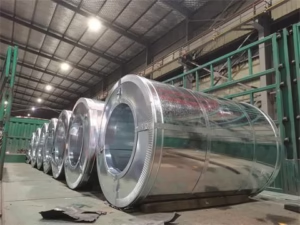
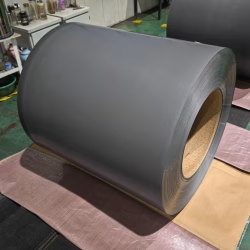
DX51D is a European standard (EN 10346) designation for hot-dip galvanized steel intended for cold forming and bending. In the code, “D” signifies a flat product for cold forming, “X” indicates that the rolling method is not specified, “51” is a sequence number denoting commercial quality (non-structural), and the final “D” confirms it is hot-dip galvanized. DX51D is the most widely used steel grade for roofing, side panels, and general household appliances due to its excellent ductility and corrosion resistance.
1. Decoding the EN 10346 Nomenclature: What Does DX51D Mean?
To ensure quality during B2B steel procurement, you must understand how the European numbering system works.
- D (First Letter): Refers to flat products for cold forming.
- X: Indicates that the rolling condition (Hot Rolled or Cold Rolled) is not specified for the substrate.
- 51: A sequence number assigned to “Commercial Quality” steel. Higher numbers like 52, 53, or 54 indicate higher drawing capabilities.
- D (Last Letter): Signifies that the coating method is Hot-Dip Galvanization.
Commonly, you will see it written as DX51D+Z. The “+Z” indicates a pure zinc coating, most often specified at the Z275 (G90) coating weight for outdoor durability.
2. Chemical Composition of DX51D Steel
The chemical makeup of DX51D is designed to maximize flexibility while maintaining basic strength. Unlike structural steels, DX51D has low carbon and silicon content to ensure it remains soft enough for folding.
2.1 Chemical Analysis Table (EN 10346)
We use the following HTML data structure for maximum Featured Snippet visibility:
Technical Note: If your project requires higher drawing depth, consider upgrading to DX54D, which has even lower carbon content for extreme elongation.
3. Mechanical Properties: Strength and Ductility
The mechanical properties of DX51D are focused on “Formability” rather than “Load-bearing.”
3.1 Tensile and Yield Values
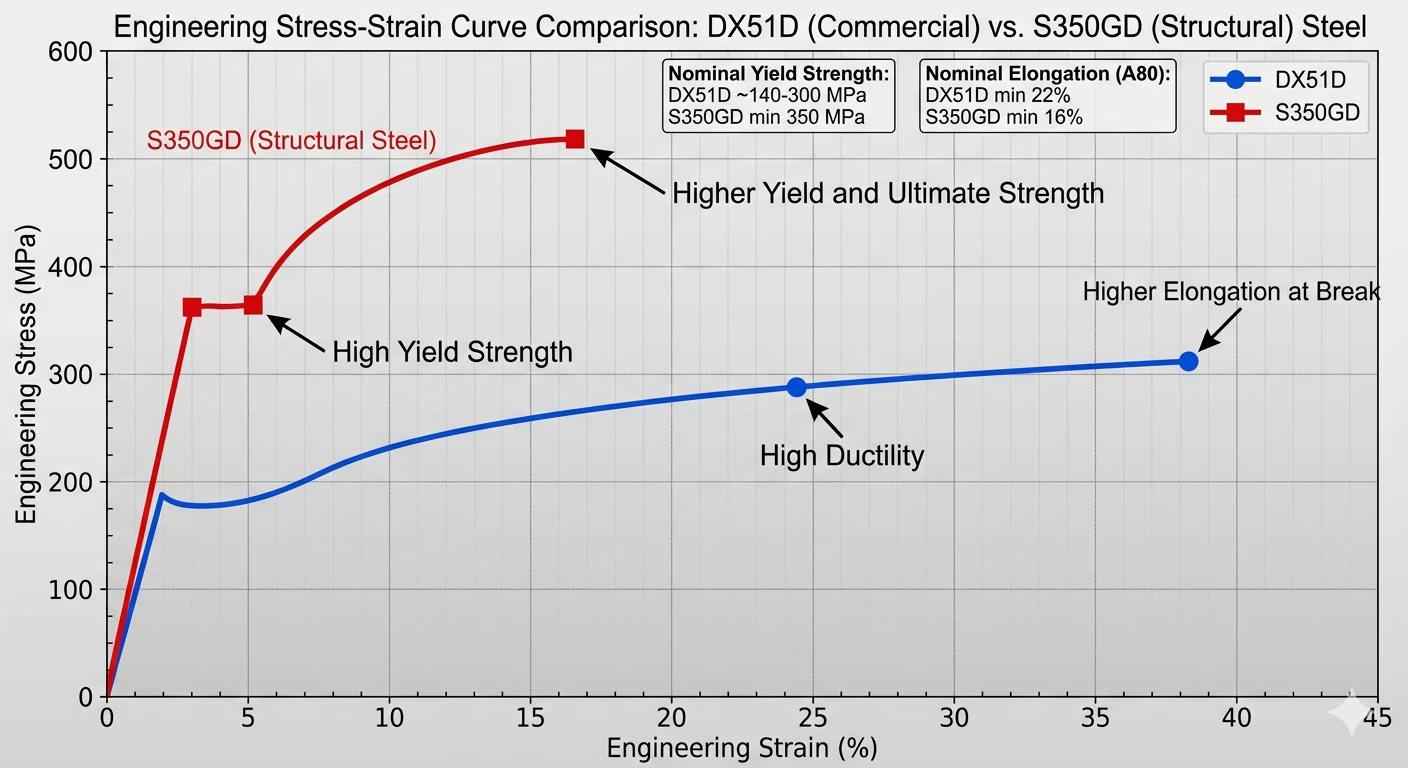
- Yield Strength (Rp0.2): Not strictly specified for DX51D, but typically ranges between 270 – 500 MPa.
- Tensile Strength (Rm): Standard range of 270 – 500 MPa.
- Elongation (A80): Minimum 22%. This high elongation is why DX51D+Z is perfect for corrugated roofing where the steel must bend without cracking.
4. Coating Types and Surface Qualities
When ordering from Zhongtang Metal, you must specify the surface finish and coating type to match your application.
4.1 Coating Designations
- DX51D+Z: Pure Zinc coating (Sacrificial protection).
- DX51D+AZ: Galvalume coating (Aluminum-Zinc alloy). Learn more: Galvanized vs. Galvalume: Complete Comparison.
- DX51D+ZF: Galvannealed coating (Zinc-Iron alloy, matte grey, excellent for painting).
4.2 Surface Quality Classes
- Class A (As Coated): Minor imperfections like pits, variations in spangle size, or light scratches are allowed. Best for hidden structural parts.
- Class B (Improved): Obtained by skin-passing (temper rolling). The surface is smoother, suitable for high-quality painting.
- Class C (Best Surface): Also skin-passed, providing a superior finish for visible automotive or appliance panels.
5. DX51D vs. Structural Steel (S235GD / S350GD)
This is a critical distinction for engineers.
- DX51D (Commercial): Focuses on Formability. Used for roofing, cladding, and ducting where the steel needs to be bent and shaped.
- S350GD (Structural): Focuses on Strength. Used for solar mounting racks and floor decks where the steel must support heavy weights.
Buying Tip: Never use DX51D for load-bearing pillars. Conversely, don’t use S350GD for complex decorative folding, as it may “spring back” or crack due to its high rigidity.
6. Global Equivalents: ASTM, JIS, and GB
If you are used to the American or Japanese standards, here is how DX51D translates:
Need to calculate the weight of your SGCC or DX51D order? Use our Steel Coil Weight Calculator.
7. Manufacturing and Bending Standards
Because DX51D is intended for “Cold Forming,” it is the default choice for roll-forming machines.
7.1 Minimum Bend Radius
To prevent the zinc coating from cracking, engineers usually follow the 2t or 3t rule (the bend radius should be 2 to 3 times the thickness of the steel). For DX51D, the excellent ductility typically allows for tighter bends than structural grades.
7.2 Welding DX51D+Z
While weldable, the zinc coating produces toxic fumes (zinc oxide). Always ensure proper ventilation and consider grinding off the zinc layer at the weld point to ensure a high-quality metallurgical bond.
8. 2026 Market Insights: Pricing DX51D
DX51D is the “Commodity King” of the steel world. Its price sets the baseline for the entire galvanized steel market.
- Current Trend: Prices in 2026 are heavily influenced by the “Green Steel” premium. DX51D produced in low-carbon mills carries a 30−50/ton surcharge.
- Live Prices: Get a real-time quote for DX51D+Z here: Steel Price Per Ton Today.
9. Frequently Asked Questions (FAQ)
Q: Can DX51D be used for outdoor roofing? A: Absolutely. When paired with a Z275 (G90) zinc coating, DX51D provides the perfect balance of flexibility for corrugated profiles and long-term corrosion resistance.
Q: What is the difference between DX51D and SGCC? A: Technically, they are equivalent. DX51D is the European (EN) code, while SGCC is the Japanese (JIS) code. Both refer to hot-dip galvanized commercial-quality steel.
Q: Is DX51D structural steel? A: No. DX51D is “Commercial Quality.” For load-bearing structures, you should specify S235GD, S280GD, or S350GD.
Q: How do I verify if I received real DX51D? A: Check the Mill Test Certificate (MTC). It must show an elongation (A80) of at least 22% and a chemical composition within the EN 10346 limits.
10. Industry Case Study: HVAC Ducting Efficiency
Client: A major HVAC contractor in the UAE. Challenge: Frequent cracking of steel during high-speed automated duct forming. Previous Material: Low-quality “Commercial Grade” with inconsistent mechanical properties. Zhongtang Solution: Switched to certified DX51D+Z140 Class B surface. Outcome: Duct-forming failure rate dropped from 4% to 0.2%. The consistent 24% elongation of Zhongtang’s DX51D allowed for seamless “Pittsburgh joints” without zinc flaking.
About the Technical Reviewer
Li Hua, Senior Quality Control Engineer Specialist in EN 10346 Compliance | 15 Years at Zhongtang Metal Quality Lab. Li Hua ensures every batch of DX51D meets the strict elongation and coating adhesion standards required for international export.
Related Technical Resources
- The Ultimate Guide to Galvanized Steel (Hub)
- Z275 Coating Weight: Why It’s the Industry Standard
- Galvanized vs. Galvalume: Detailed Comparison
- Galvanized Steel Price Forecast 2026